Why Mangroves Still Matter for Indonesia’s Coastal Ponds
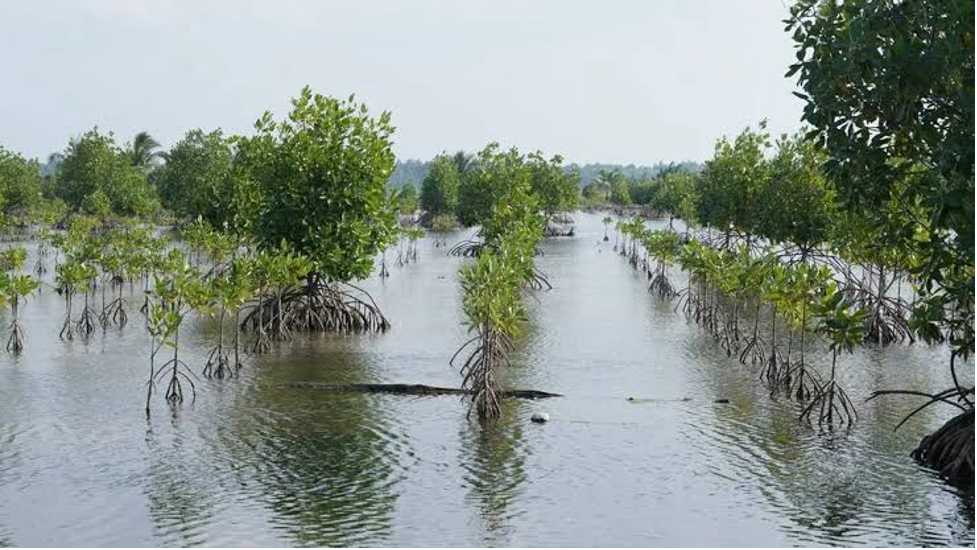
Mangrove trees integrated into coastal ponds (Photo Credit : Kompas.id)
The Coastline We Share
Along Indonesia’s coast, mangroves and aquaculture ponds are part of the same landscape. For many coastal communities, ponds provide food, income, and employment. Mangroves, meanwhile, support a wide range of ecological functions, from providing habitat for aquatic species to storing carbon and helping maintain coastal conditions.
For decades, however, the expansion of aquaculture has often come at the expense of mangrove forests. When mangroves are cleared to make room for ponds, the change is not simply a matter of replacing trees with productive land. It also changes how the coastal system functions. Yet the relationship between mangroves and aquaculture is more complex than a simple choice between conservation and production.
A study in Subang, West Java, by Sumarga et al. (2022) found that ponds with higher mangrove cover stored more carbon, while fish production and net income did not differ significantly among ponds with different levels of mangrove cover. The finding matters because it challenges a common assumption: keeping mangroves does not necessarily mean giving up aquaculture production.
The real question, therefore, may not be whether coastal ponds should have mangroves, but how the two can function together as parts of the same coastal landscape.
When Mangroves Disappear, What Changes?
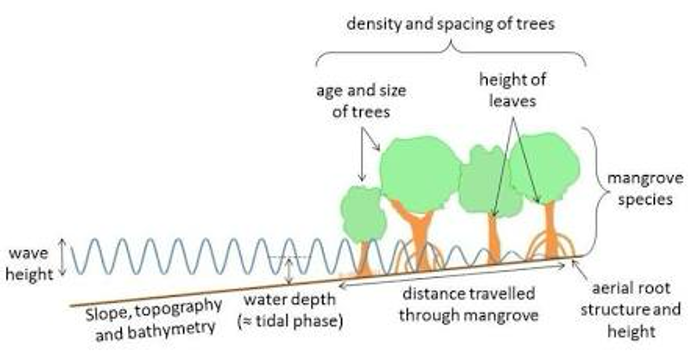
Factors influencing mangrove wave reduction efficiency (Photo Credit : Researchgate)
Mangroves do more than occupy space along the shoreline. They change the way water moves through the coast. Their stems, trunks, and roots create resistance that can reduce wave energy before it reaches the shore.
They also influence what happens to sediment. As water slows within a mangrove forest, suspended particles can settle and accumulate. The roots and below-ground structure help hold these sediments in place, contributing to a more stable coastal surface.
When mangroves disappear, these natural processes are weakened. Waves and currents can reach exposed shorelines and pond dikes with less resistance, increasing pressure on coastal land and aquaculture infrastructure. But the protective effect of mangroves is not simply a matter of having trees or not having trees. Research on wave attenuation shows that the amount of energy reduced by a mangrove forest changes with vegetation structure, water depth, tidal conditions, and location. In other words, the same width of mangrove does not necessarily provide the same level of protection everywhere. This leads to an important point: it is not simply whether mangroves are there. Their amount and structure matter.
Mangroves Do More Than Protect the Shore
Milkfish aquaculture in coastal Indonesian ponds (Photo Credit : Indonesian Ministry of Marine Affairs and Fisheries (KKP) / Local Aquaculture Studies)
Protecting the shoreline is only part of what mangroves do. A healthy mangrove system is also a place where water, sediment, nutrients, and living organisms interact. The forest provides habitat for fish, crustaceans, and other aquatic organisms. Its sediments support nutrient processes, while the trees and soils store carbon.
These functions matter for aquaculture too. What happens inside a pond is not completely separated from what happens around it. A recent study by Novida et al. (2025) illustrates this connection in Indonesian silvofishery ponds. The study compared ponds with 40%, 20%, and no mangrove cover and examined water quality, plankton, benthic organisms, and milkfish productivity.
The point is not that one particular percentage is the answer for every pond. Rather, it shows that changing mangrove cover can be associated with changes in several ecological and production-related conditions at the same time. And this is where the story becomes less straightforward.
But More Mangrove Is Not Automatically Better
By now, it may be tempting to think that the answer is simple: keep as much mangrove as possible. But more is not automatically better for aquaculture production. Mangroves and ponds both need space, and the way mangroves are arranged can also influence how the system functions.
Silvofishery systems therefore take many forms. Some retain mangroves around the edges of ponds, while others integrate trees within the pond area. These different arrangements can create different conditions for both the mangroves and the cultured species. The important lesson is that mangrove cover matters, but the relationship between mangroves and aquaculture is not a straight line. That also means that simply planting more trees is not always the answer, especially when the coastline has already changed significantly.
When Mangroves Need a Little Help
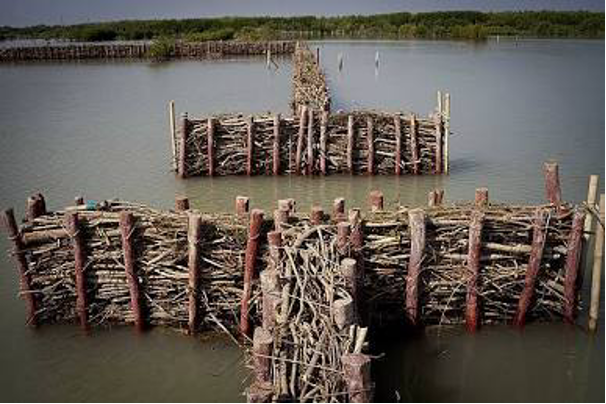
Permeable structures trapping sediment in Demak (Photo Credit : International Climate Initiative (IKI) / EcoShape & Wetlands International)
Mangroves can protect coastlines, but they cannot always return on their own. On severely eroded shores, the sediment needed for mangrove recovery may be limited, while waves can remain too strong for young mangroves to establish.
This is where coastal engineering can help. Rather than relying only on hard structures, some projects combine small-scale engineering with natural processes. Permeable structures, for example, can slow water and trap sediment. Once the shoreline becomes more stable, mangroves can begin to regenerate and gradually become part of the coastal protection system.
Demak, Central Java, provides one of Indonesia’s best-known examples. Through the Building with Nature approach, permeable structures were used to help restore sediment conditions and encourage natural mangrove regeneration, while the wider program also worked with communities on sustainable aquaculture and coastal management. The idea is simple: engineering does not always have to replace nature. Sometimes, it can create the conditions for nature to work again.
But this approach also comes with an important lesson. Coastal systems are different from one place to another. What works on one shoreline cannot simply be copied elsewhere without understanding the local waves, tides, sediment, land use, and condition of the mangroves.
The Question We Still Need to Answer
We now know that mangroves can protect the coast, support ecological processes, store carbon, and coexist with aquaculture. We also know that simply asking whether mangroves are present is not enough. Their cover, structure, and arrangement matter. And the response of aquaculture may not change in the same way as the ecological functions around it. So perhaps the most useful question is not "Should we have mangroves or ponds?” It is: “How much mangrove is enough?”
That question matters because a coastal pond is not an isolated production unit. It is part of a larger system where trees, water, sediment, organisms, farmers, and infrastructure interact. Finding the right balance will not mean choosing one over the other. It means understanding where mangroves provide the greatest benefits, how those benefits change as mangrove cover changes, and how aquaculture responds along the way.
A Future Where Both Can Stay
Indonesia does not have to choose between productive coastal ponds and healthy mangroves. The challenge is to understand how the two can exist together and how coastal management can give both enough space to function. Mangroves are not simply trees standing between the sea and a pond. They are part of the system that surrounds the pond. And the future of Indonesia’s coastal aquaculture may depend on understanding just how much of that system needs to remain.
-Rika Novida
References
Sumarga, E., et al. (2022). Maintaining Carbon Storage Does Not Reduce Fish Production from Mangrove-Fish Pond System: A Case Study in Coastal Area of Subang District, West Java, Indonesia. Forests, 13, 1308.
Zhang, Y., et al. (2020). Non-linear wave attenuation quantification model improves the estimation of wave attenuation efficiency of mangroves. Estuarine, Coastal and Shelf Science, 245, 106927.
Novida, R., et al. (2025). The Impact of Mangrove on Water Quality and Milkfish Productivity in the Silvofishery Ponds in Sawojajar Village, Brebes Regency. Coastal and Ocean Journal, 9(1), 70–86.
Tonneijck, F., van der Goot, F., & Pearce, F. (2022). Building with Nature in Indonesia: Restoring an Eroding Coastline and Inspiring Action at Scale (2015–2021). Wetlands International & EcoShape.