

Sea Slugs (Nudibranchs): The Colorful Jewels of Coastal Reefs
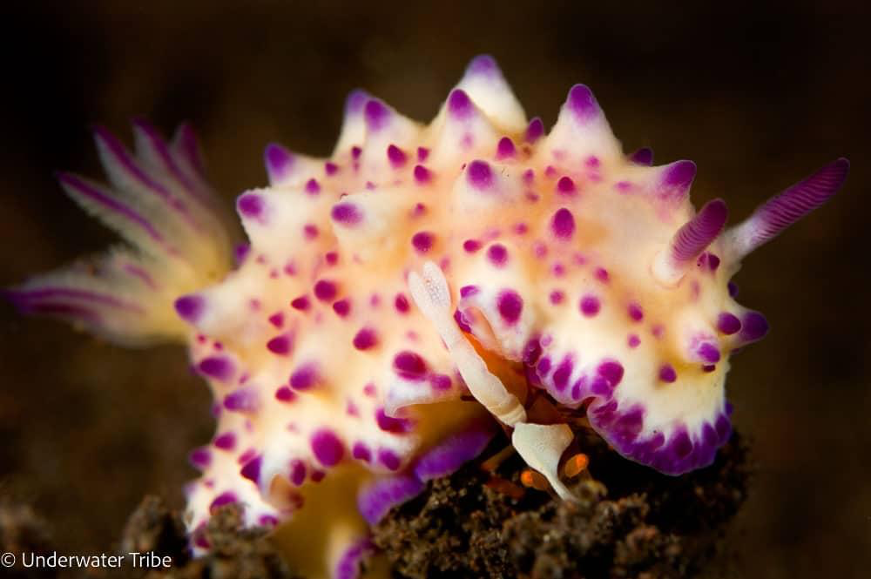
A colorful nudibranch on the reef floor (Photo Credit : Underwater Tribe)
Beneath the stunning expanse of tropical coral reefs lies a group of tiny marine organisms with striking colors and body shapes resembling abstract works of art. These organisms are sea slugs, or nudibranchs, a group of shell-less marine mollusks known as some of the most colorful animals in the ocean. Their beauty often leads divers to call nudibranchs the “living jewels” of tropical coastal ecosystems. Yet behind their artistic appearance, nudibranchs play important ecological roles, serve as indicators of ecosystem health, and even hold great potential in marine biotechnology.
Nudibranchs belong to the class Gastropoda and the subclass Heterobranchia. The name “nudibranch” comes from the Latin word nudus, meaning naked, and the Greek word brankhia, meaning gills, referring to their exposed external gills. Unlike land snails or many other sea snails, most nudibranchs lose their shells as adults. Instead, they develop unique defense strategies such as vivid coloration, toxic chemicals, and even the ability to store stinging cells taken from their prey.
Beauty with a Survival Strategy
One of the most fascinating characteristics of nudibranchs is their highly contrasting body coloration, ranging from electric blue, bright yellow, orange, and pink to intricate geometric patterns. These colors are not merely decorative; they are part of a defense strategy known as aposematic coloration, warning predators that they are toxic or unpalatable.
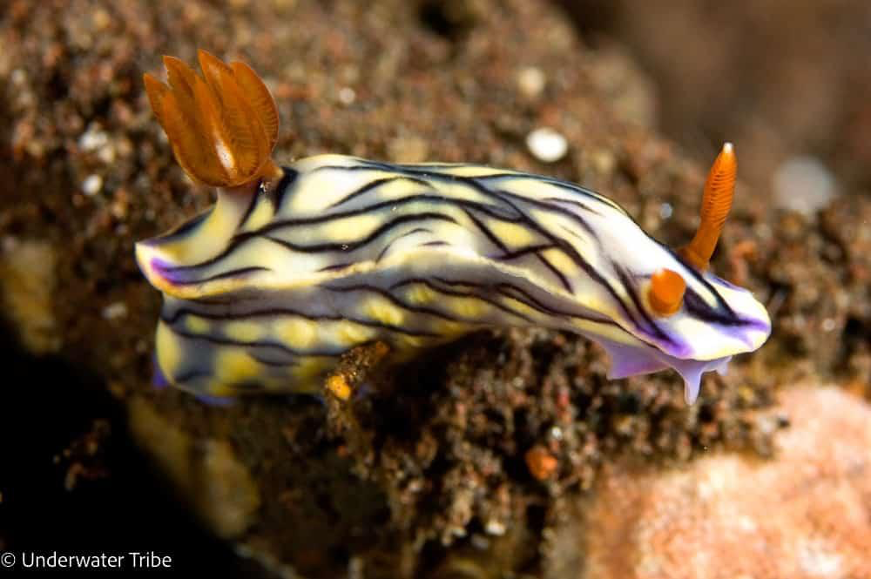
A vividly patterned nudibranch displays its striking colors and intricate textures on the tropical seabed (Photo Credit : Underwater Tribe)
Some nudibranch species obtain toxic chemical compounds from the sponges, hydroids, or soft corals they consume. These compounds are then stored within their body tissues as a defense mechanism.
Even more remarkably, some nudibranchs can “steal” nematocysts, or stinging cells, from cnidarians such as anemones and hydroids. These cells are stored within their tissues and reused to protect themselves from predators. This phenomenon makes nudibranchs one of the most unique examples of evolutionary adaptation in marine environments.
Loyal Inhabitants of Tropical Coral Reefs
Nudibranchs are commonly found in tropical coastal habitats such as coral reefs, seagrass beds, and shallow rocky areas. The Indo-Pacific region, particularly the Coral Triangle encompassing Indonesia, the Philippines, and Papua New Guinea, is recognized as the global center of nudibranch diversity.
Indonesia has become one of the most important locations for nudibranch studies due to the extraordinary complexity of its coastal habitats. Waters such as Raja Ampat, Lembeh, Bali, Komodo, and Jepara are renowned for their exceptional nudibranch diversity.
Lembeh Island in North Sulawesi has even become an international destination for underwater photographers because of its rich “macro life,” including nudibranchs. The volcanic sand habitats and coral reefs in the area provide ideal microhabitats for various nudibranch species rarely found elsewhere.
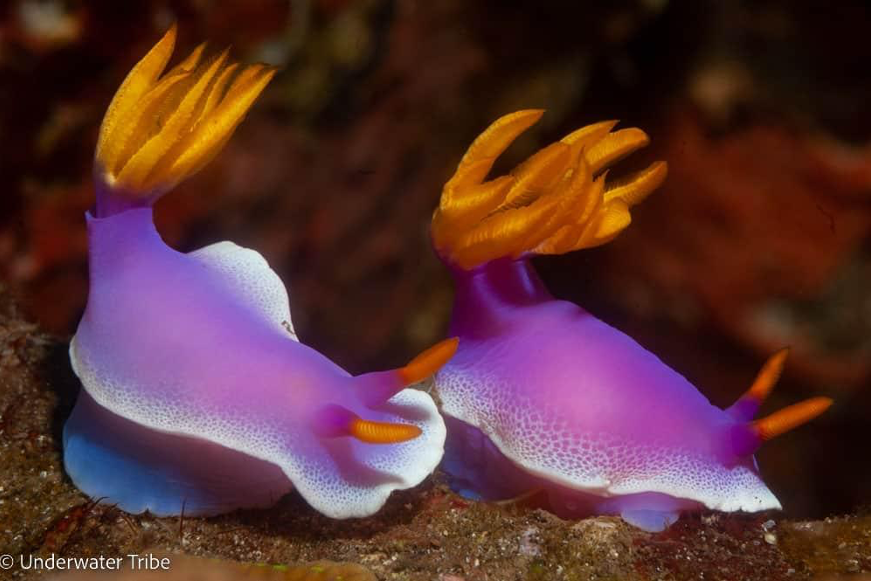
Two brightly colored nudibranchs (Hypselodoris apolegma) crawl across the reef (Photo Credit : Underwater Tribe)
Several nudibranch species recorded in the Sulawesi Sea include Chelidonura varians, Pteraolida sp., Chromodoris annae, Chromodoris colemani, Chromodoris dianae, Hypselodoris apolegma, Hypselodoris tryoni, Phyllidia elegans, and Thuridilla lineolata.
Indicators of Coastal Ecosystem Health
Despite their small size, nudibranchs hold significant ecological value. Many researchers have begun using nudibranchs as bioindicators of coral reef health and coastal environmental quality. This is due to their sensitivity to habitat changes, sedimentation, pollution, and other environmental disturbances.
Studies conducted in the coastal areas of Jepara, including Panjang Island and Karimunjawa Island, showed that different sedimentation levels affect nudibranch abundance and diversity.
Habitats with high sedimentation tend to support fewer species compared to reefs in healthier conditions. As sedimentation increases, sponge cover and other benthic organisms that serve as food sources for nudibranchs are also disrupted.
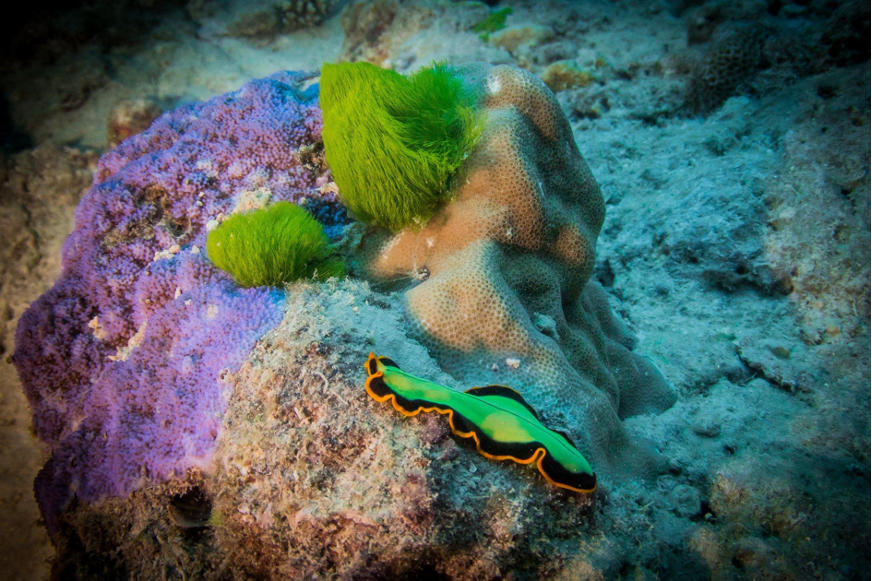
A nudibranch glides across a coral reef (Photo Credit : Great Barrier Reef Liveaboards)
In addition to sedimentation, global climate change also places major pressure on nudibranch habitats. Rising sea temperatures cause coral bleaching and declining reef health in many parts of the world.
Hidden Diversity Still Waiting to Be Discovered
Although nudibranchs have long been admired by divers and underwater photographers, their diversity remains far from fully understood. Recent molecular studies reveal that many nudibranch species actually consist of several hidden evolutionary lineages, or cryptic species, which appear morphologically similar but are genetically distinct.
These findings suggest that global nudibranch biodiversity may be far greater than currently described scientifically. Such research is crucial for conservation because species protection cannot be effectively implemented if their biological identities are not clearly understood.
Potential in Pharmaceuticals and Biotechnology
Beyond their ecological and aesthetic value, nudibranchs have also attracted scientific attention because of the bioactive compounds found within their bodies. Many species produce secondary metabolites with antibacterial, anticancer, antifungal, and antiviral properties.
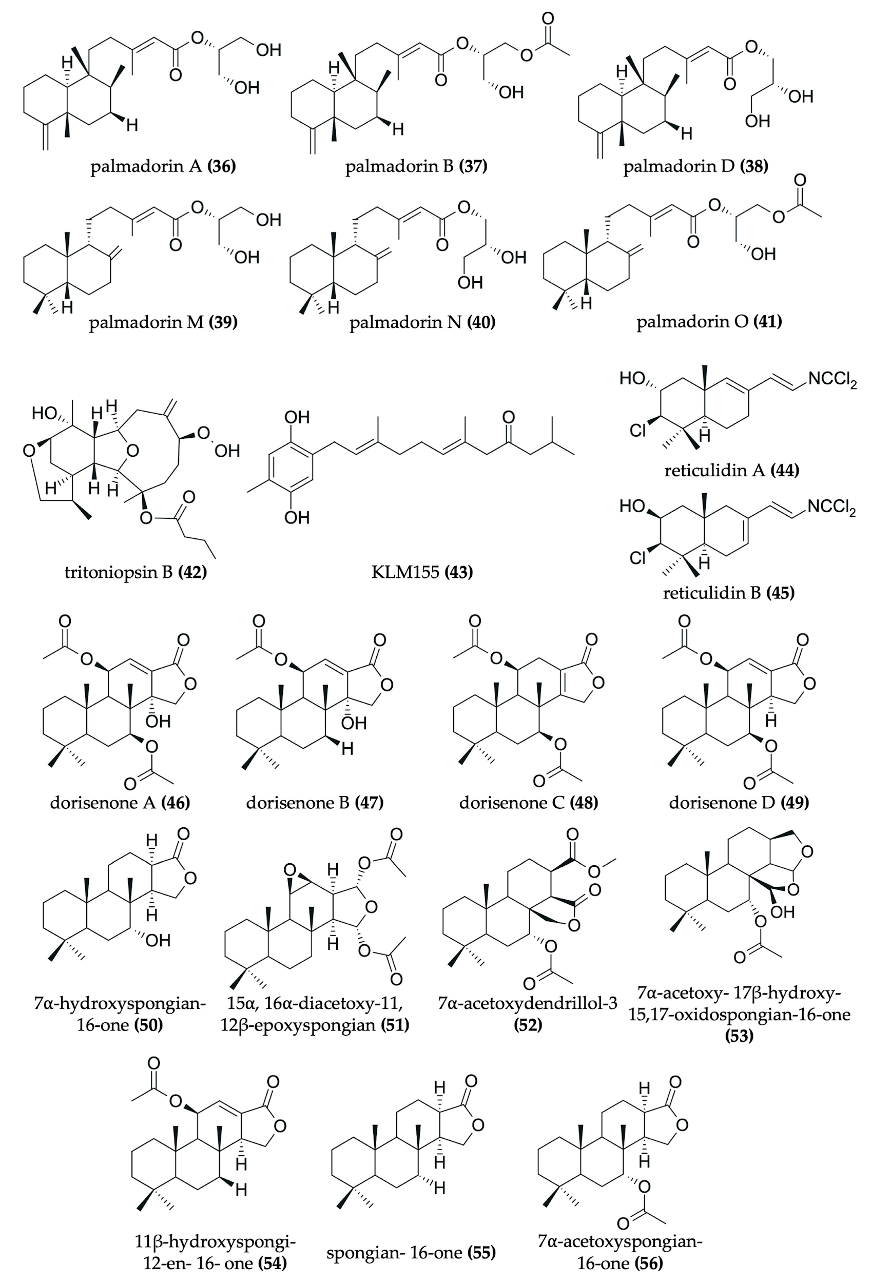
Chemical structures of antitumor compounds isolated from nudibranchs (Photo Credit : Servillera, et al.)
Most of these compounds originate from their diet, particularly marine sponges that are already known to contain abundant natural chemicals.
Chemical studies of Indonesian nudibranchs have identified various diterpene-derived compounds with strong potential for the development of modern medicines.
Threats to Tropical Marine Jewels
Although nudibranchs appear abundant in certain diving locations, they face serious threats due to global coastal ecosystem degradation. Coral reef destruction, sedimentation, marine pollution, environmentally harmful tourism, and climate change are among the primary factors threatening their habitats.
Additionally, the growing popularity of underwater macro photography must be balanced with conservation ethics. There have been numerous cases where divers move or touch nudibranchs simply to obtain better photographs, even though these organisms are highly sensitive to physical disturbance and microhabitat changes.
Protecting the Tiny Wonders of Tropical Seas
Nudibranchs may not be as massive as whale sharks or as iconic as sea turtles, but their presence reflects the complexity and health of tropical coastal ecosystems. They are an important part of marine food webs, indicators of habitat quality, and sources of both scientific and artistic inspiration.
Indonesia, as one of the world’s centers of marine biodiversity, carries a major responsibility to protect coastal habitats that support thousands of small and still poorly understood species, including nudibranchs.
Amid the growing threats of global climate change, nudibranchs remind us that even organisms only a few centimeters long can play a major role in maintaining the balance of marine ecosystems. Their beauty is not merely an object of underwater photography, but a symbol of the extraordinary coastal biodiversity that must be protected together.
-Yuni Sulaiman