

Pencil Sea Urchin: Armored Grazer in Coral Reef Ecosystems
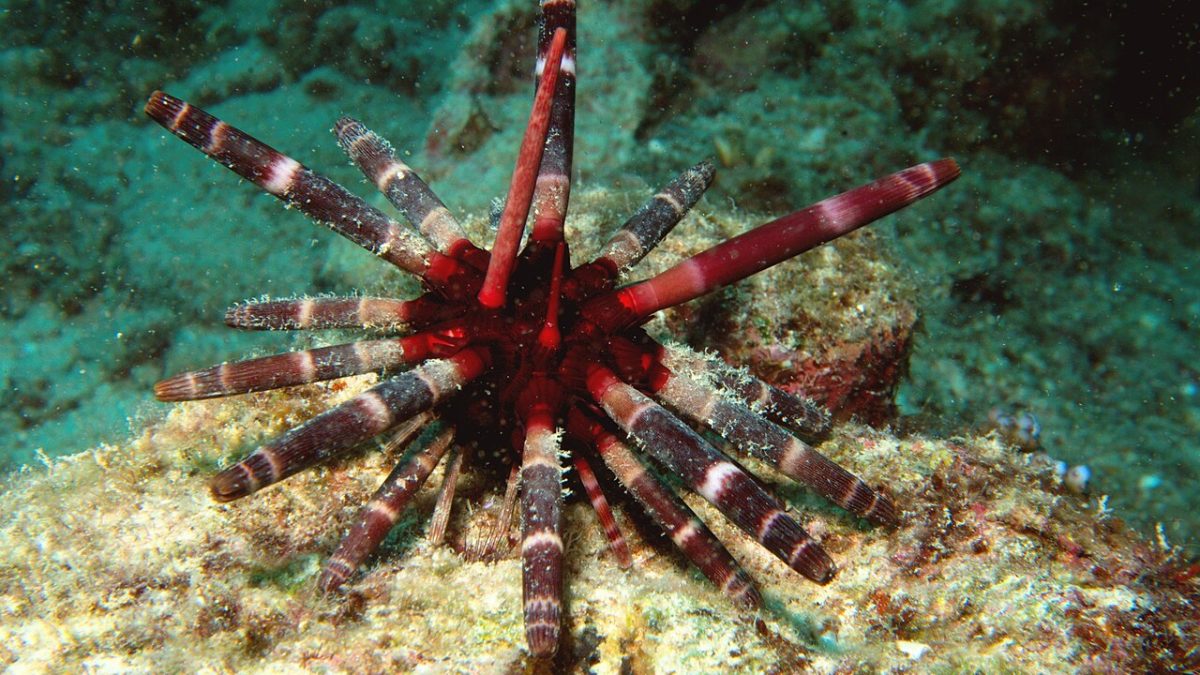
A red pencil sea urchin on a coral reef (Photo Credit : François Michonneau)
Between the crevices of tropical coral reefs, a thick spiny animal moves slowly over the surface of the rocks. It's not as popular as reef fish, turtles, or manta rays, but its existence holds an important story of how a reef maintains its balance.
The animal is the pencil urchin, a group of sea urchins with large, sturdy primary spines that are characteristic of the Cidaridae family. Some of its members are grazers that utilize algae and organisms that grow on the surface of the substrate. This activity makes them part of a network of ecological interactions that can affect the condition of reef benthic communities.
However, does more sea urchins mean the healthier the coral reef is?
The answer is not that simple, Behind the pencil-like thorns lies an important lesson about conservation: the health of reefs is determined not only by how many corals are alive, but also by how different organisms interact to maintain ecosystem function.
Getting to Know Pencil Piping
Pencil sea urchins belong to the group Cidaridae Gray, 1825, in the phylum Echinodermata and the class Echinoidea. The most recognizable feature is its relatively large, thick, and sturdy primary spines—making them look like pencil rods.
The term pencil urchin itself is a common name, not a scientific name for one species. The family Cidaridae includes a number of genera and species with diverse characters and habitats.
One known example in the Indo-Pacific region is Phyllacanthus imperialis (Lamarck, 1816). This species has a relatively large body with thick primary spines and is found on the tropical reefs of the Indo-Pacific. This species is generally nocturnal and can be found hiding in holes or crevices in substrate during the day.
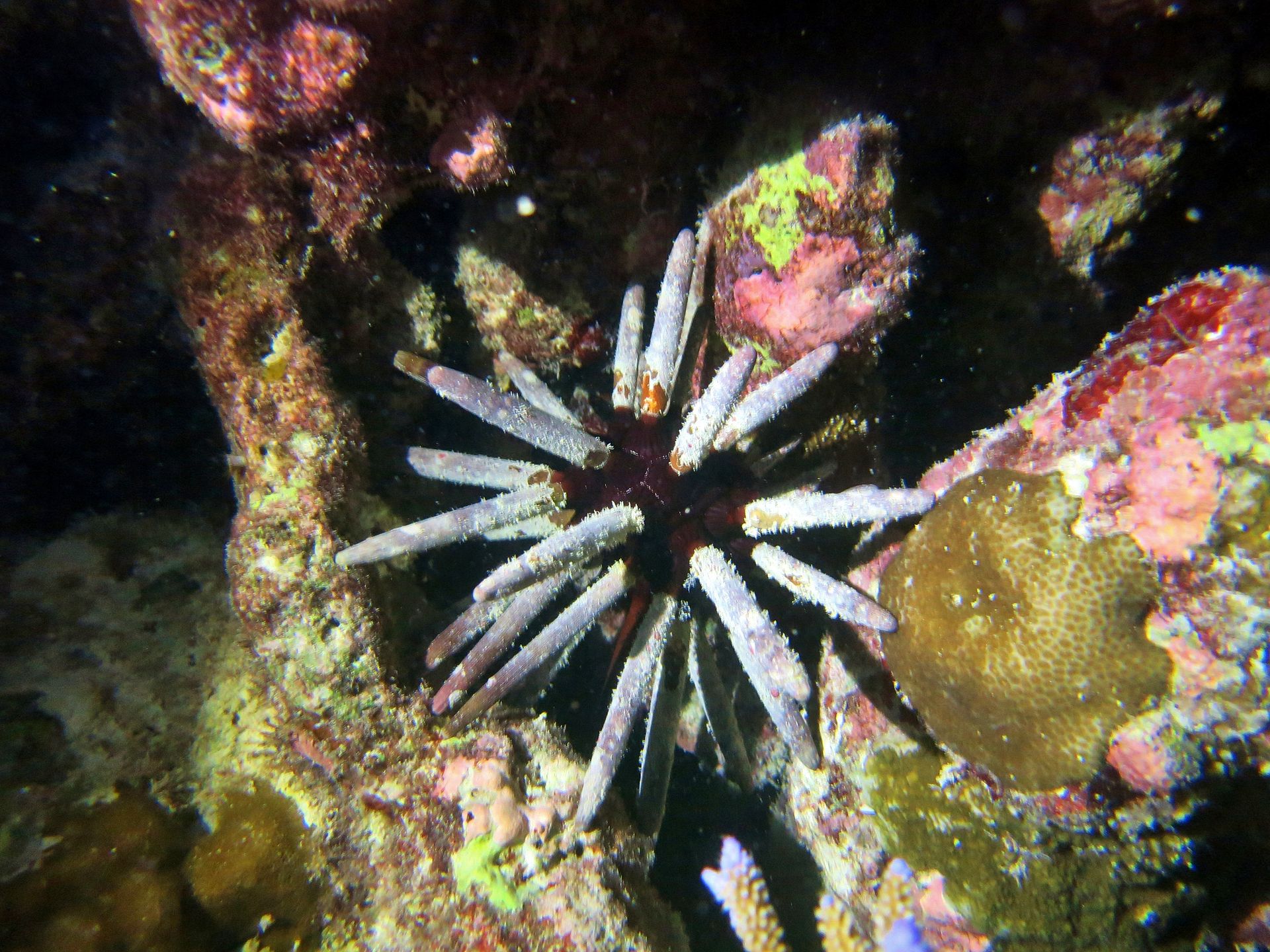
Phyllacanthus imperialis in Maldives (Photo Credit : MDC Seamarc Maldives)
In the Indonesian context, groups of sea urchins like this are important not only because of their biodiversity value, but also because their activities are part of the ecological processes that take place at the bottom of the reef.
Why Are They Called "Armored Grazers"?
Think of the surface of a reef as a space that is constantly being contested.
Corals need substrate to grow and recruit new individuals. At the same time, algae, sponges, microorganisms, and other benthic organisms also try to occupy the available space. When corals die due to disturbance, the empty space can soon turn into a breeding ground for other organisms, including algae.
Under certain conditions, herbivores can help control algae biomass and maintain potential space for coral colonization. This is where sea urchins derive their ecological role.
As part of the herbivore and grazer group, some sea urchins can consume algae that grow on the surface of the substrate. Experimental studies in Bora-Bora show that the two species of sea urchins are capable of consuming a wide range of macroalgae and that grazing could potentially help maintain conditions that favor coral dominance when herbivorous pressure is high enough.
But the term grazer does not mean that sea urchins only eat algae. The diet of sea urchins can be opportunistic and is greatly influenced by the type of food available in its habitat. Therefore, its ecological function needs to be understood as part of community interaction, not just a simple relationship between "sea urchins" and "algae".
When Algae and Corals Compete
One of the challenges for stressed reefs is the changing balance between corals and other benthic organisms. When corals lose space, algae can develop and occupy the surface of the substrate. Under certain conditions, the dominance of macroalgae can complicate the colonization process and the development of new corals.
Herbivore then becomes one of the mechanisms that can influence the direction of the change. By consuming algae and organisms growing on the surface of the substrate, the grazer can alter the structure of the benthic community. Ecologically, these activities can help maintain space that could potentially be used by corals.
But the relationship is not a simple equation: more sea urchins ≠ automatically more corals. Reefs are a much more complex system. The success of coral recruitment also depends on the availability of substrates, environmental conditions, the presence of mother corals, habitat quality, predation pressure, recruit mortality, and interaction with other organisms.
Therefore, grazing should be viewed as one of the ecological processes that contribute to reef dynamics, not as the only determinant of coral health.
Lessons from Karimunjawa
Tarigan et.al research published in 2024 examines the dynamics of coral recruitment in Karimunjawa National Park, Central Java. The study used monitoring data from 43 locations and two depths during 2013–2022, looking at the relationship between coral recruitment and a number of biological factors, including sea urchins, herbivorous fish, and hard coral cover.
The results of the analysis showed that in some observation periods, sea urchins density had a positive relationship with coral recruitment. These findings suggest that herbivorous groups deserve consideration in understanding the dynamics of reef restoration and in conservation planning in Karimunjawa.
However, the findings need to be read carefully. Statistical relationships do not necessarily prove that an increase in sea urchins directly leads to an increase in coral recruitment. Coral recruitment is a complex process that is influenced by many ecological factors.
The important message is even more broad: reef restoration needs to consider herbivorous communities and the ecological processes they run.
Not All Grazing Is Always Profitable
In conservation, we are sometimes tempted to divide organisms into "good" and "bad". Even though the ecosystem doesn't work like that.
Grazing can help reduce algae, but herbivore feeding activities can also affect other benthic organisms. The effects depend on species, density, feeding behavior, substrate conditions, and community structure.
Studies on herbivore restoration on reefs even emphasize that the addition or recovery of grazer populations needs to consider possible unintended impacts. Not all herbivore increases will result in the same ecological response on every reef.
Therefore, conservation should not aim to simply increase the number of sea urchins. What needs to be maintained is the balance of its ecological functions in reef communities.
From "Calculating" to "Understanding Functions"
Coral reef surveys have so far used many indicators such as live coral cover, macroalgae cover, fish abundance, and water quality. All of these indicators remain important. But the ecosystem approach invites us to ask a further question:
What is the function of such organisms in the ecosystem?
For sea urchins, it is not enough just to know how many individuals there are.
We also need to understand:
- what species are present
- how the population structure is<
- what he eats
- how grazing activity relates to algae cover
- how the conditions of the substrate change
- how it relates to coral recruitment
- how human pressure affects the overall interaction
This approach transforms sea urchins from mere objects of biodiversity to part of indicators of reef ecological processes.
What Does It Mean for Indonesian Reef Conservation?
Indonesia is at the center of the Coral Triangle region, one of the regions with the highest coral reef biodiversity in the world. Coral reefs not only provide habitat for marine organisms, but also sustain fisheries, tourism, coastal protection, and livelihoods for communities.
Therefore, reef conservation is not enough just to maintain coral cover. Management needs to maintain ecological functions and processes that allow reefs to cope with disturbances and recover. In this context, herbivorous communities—including sea urchins—deserve to be part of ecosystem monitoring.
Some of the approaches that can be strengthened include:
- Grazer Community Monitoring : Not only calculating abundance, but also paying attention to the composition and structure of the community.
- Connecting the grazer with benthic conditions : Sea urchin data can be read alongside coral cover, macroalgae, and coral recruitment.
- Maintaining habitat quality : Grazer populations are inseparable from environmental quality, habitat structure, and anthropogenic stresses.
- Maintains herbivorous diversity : Sea urchins do not work alone. Herbivorous fish and other organisms also perform different functions in the ecosystem.
Thus, the goal of management is not to create "as many sea urchins as possible", but rather to maintain a network of interactions that keep the ecosystem functioning.
Healthy Reefs are Functional Reefs
Pencil quills teach us a simple but important perspective. Coral reefs are not just a collection of coral colonies. It is a system of life.
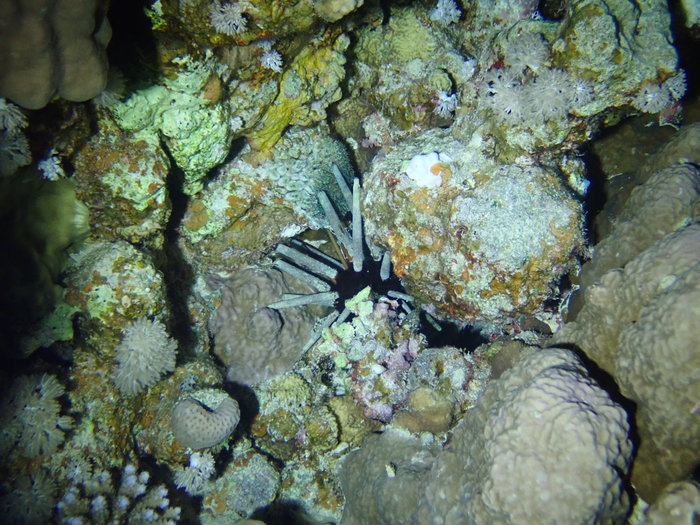
Phyllacanthus imperialis at Suil Island, Red Sea (Photo Credit : Martina Holzknecht)
Corals build habitat structures, erbivores influence the growth of algae, predators regulate populations of other organisms, microorganisms carry out biogeochemical processes, various benthic organisms compete with each other and interact to gain space. If one component changes, the other can change as well.
Therefore, the success of reef conservation should be measured not only by how much coral is still alive, but also by whether the ecological processes that sustain the reef are still running.
This is where pencil sea urchins become interesting. This animal may not be spectacular, it moves slowly, hides in the crevices of the reef and some of its activity takes place when most humans are not looking at it. But those small activities are part of a much larger ecological process.
The Thorny Little One with a Big Job
Perhaps we will never see pencil sea urchins as a conservation icon like turtles or manta rays. However, conservation doesn't just require popular species. Conservation requires an understanding of how ecosystems work.
Pencil sea urchins remind us that caring for reefs is not just about caring for corals, but also caring for organisms and interactions that allow reefs to survive and recover.
Therefore, when diving or taking your next survey on tropical reefs, don't just look for colorful fish or beautiful corals. Also notice the spiny creatures moving slowly between the rocks.
Behind those pencil-like thorns, there is a small part of the ecological machinery that keeps the reef alive.
-Yuni Sulaiman
SCIENCE NOTE
Common name: Pencil urchin / pencil sea urchin
Group: Cidaroid sea urchins
Family: Cidaridae Gray, 1825
Order: Cidaroida
Class: Echinoidea
Phylum: Echinodermata
Example species: Phyllacanthus imperialis (Lamarck, 1816)
P. imperialis is one of the species of isolated urchins of the family Cidaridae found in the Indo-Pacific region. This species has large, sturdy primary spines, and is known to be associated with shallow tropical reefs and is active especially at night.
Important note: the term pencil urchin does not refer to just one species. Therefore, identification down to the species level requires an adequate examination of morphological characters and, where necessary, further taxonomic approaches.
References
Tarigan, S. A. R., Munasik, Wijayanti, D. P., Muhidin, Rohman, E. A., & Pardede, S. (2024). Dynamic of coral recruits in the Karimunjawa National Park, Central Java, Indonesia. Biodiversitas, 25(2), 869–880. https://doi.org/10.13057/biodiv/d250247.
Herbivory effects of sea urchin species on a coral reef (Bora-Bora, French Polynesia). (2023). Journal of Experimental Marine Biology and Ecology, 564, 151900. https://doi.org/10.1016/j.jembe.2023.151900.
Restoration of herbivory on Caribbean coral reefs: are fishes, urchins, or crabs the solution? (2024). Frontiers in Marine Science, 11. https://doi.org/10.3389/fmars.2024.1329028.
Phyllacanthus imperialis (Lamarck, 1816) Western Australian Museum Collections. Data on the morphology, habitat, behavior, and distribution of the Indo-Pacific.
Phyllacanthus imperialis (Lamarck, 1816) Atlas of Living Australia/Australian Faunal Directory. Taxonomic classification data.