Living with a New Shoreline: Community Challenges After Coastal Uplift in Mindanao
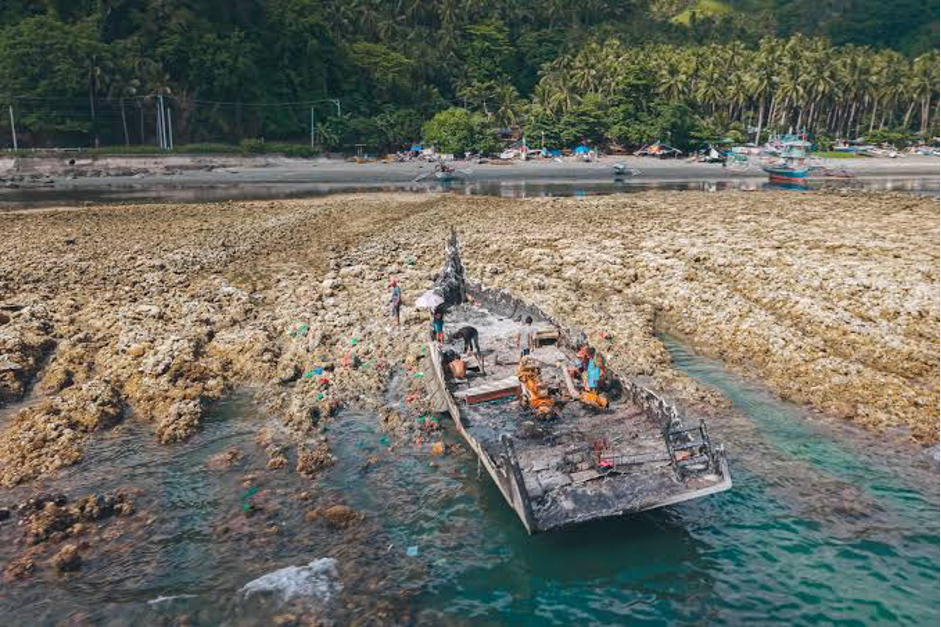
The changed shoreline creates new challenges for coastal communities (Photo Credit: Ferdinandh Cabrera)
For many coastal communities in Mindanao, the shoreline is more than a geographic boundary—it is the center of daily life. Families depend on the sea for fishing, transportation, small businesses, and cultural traditions that have been passed down through generations. Homes, schools, markets, and community spaces are often built with the expectation that the coastline will remain relatively stable. However, powerful earthquakes can dramatically alter that assumption through a phenomenon known as coastal uplift.
When the land suddenly rises due to tectonic activity, the coastline can shift hundreds of meters seaward almost overnight. Areas that were once underwater become dry land, while established boat landings, fishing grounds, and coastal infrastructure no longer function as they once did. Although the newly exposed land may seem like an opportunity, the reality for local residents is often one of uncertainty and adjustment.
Living with a new shoreline means learning how to navigate a landscape that has permanently changed. Communities must rethink how they fish, travel, earn a living, and interact with the environment while recovering from the earthquake itself.
Daily Life Changes Overnight
One of the most immediate challenges after coastal uplift is the disruption of everyday routines.
Before the uplift, fishermen may have launched their boats directly from the beach outside their homes. After the land rises, those same boats may be stranded far from the water’s edge, requiring people to drag heavy vessels across newly exposed coral or rocky terrain. What was once a quick trip to sea can become a physically demanding task that takes significantly longer each day.
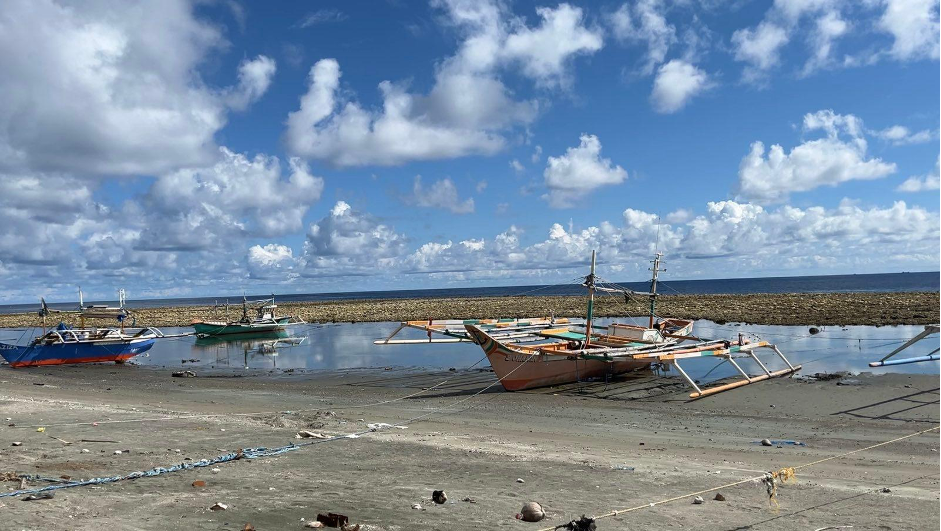
Fishing boats in Barangay Pangyan, Glan, Sarangani, are trapped as the shoreline receded by 200 meters following the coastal uplift caused by the June 8 magnitude 7.8 earthquake (Photo Credit: Jelo Ritzhie Mantaring/Rappler)
Residents who relied on small docks or community piers often discover that these structures no longer reach the water. Some become unusable altogether, forcing people to build temporary access points or travel to neighboring villages where boats can still dock safely.
Even simple activities such as collecting shellfish, transporting supplies, or visiting nearby islands may require entirely new routes and routines.
Livelihoods Under Pressure
Fishing is one of the primary sources of income for many coastal communities in Mindanao. Coastal uplift can affect nearly every aspect of this livelihood.
Traditional fishing areas may become too shallow or inaccessible, while coral reefs exposed above sea level lose much of the marine life they once supported. Fish populations may move to deeper waters, requiring fishermen to travel farther offshore. This increases fuel costs, equipment wear, and the amount of time spent away from home.
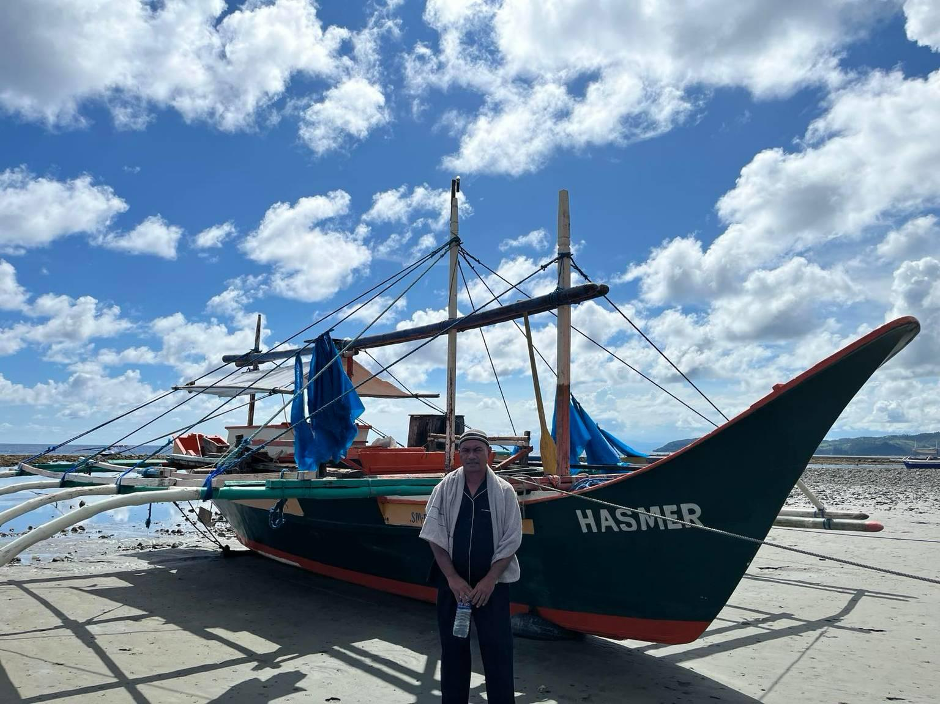
Fisherman Genn Abubacar cannot set sail to fish as his boat was trapped following the coastal uplift along the coastline of Barangay Pangyan, Glan, Sarangani (Photo Credit: Jelo Ritzhie Mantaring/Rappler)
For families with limited financial resources, purchasing larger boats or more powerful engines is often impossible. As a result, household incomes may decline even as daily expenses increase.
Communities that depend on seaweed farming, shellfish gathering, or fish cages face similar challenges. Areas that once had suitable water depth may become unusable, forcing farmers to relocate their operations or temporarily stop production altogether. Recovery can take months or even years, depending on the availability of resources and suitable replacement sites.
Rebuilding Community Infrastructure
Coastal uplift affects more than individual livelihoods—it changes how the entire community functions.
Small ports, jetties, and boat ramps may no longer be positioned correctly after the shoreline shifts. Roads leading to fishing areas may need to be extended, while pathways that once ended at the sea suddenly continue across newly exposed land.
Community leaders often face difficult decisions about whether to repair existing infrastructure or invest in building entirely new facilities closer to the water. These projects require funding, engineering expertise, and careful planning, which may not be immediately available after a major earthquake.
Essential services can also be disrupted. Deliveries of food, fuel, construction materials, and medical supplies may become more difficult if transportation routes are affected. Schools, health centers, and local markets may experience temporary interruptions while access is restored.
Emotional and Cultural Adjustment
The coastline often carries deep personal and cultural meaning. Families may have lived beside the same beach for generations, with memories tied to familiar landmarks, fishing grounds, and gathering places.
When coastal uplift permanently changes these landscapes, residents may experience a sense of loss even though their homes remain standing. Places where children learned to swim, elders launched fishing boats, or families celebrated local traditions may no longer exist in the same form.
Older residents, in particular, may find it difficult to adjust to a coastline that no longer matches the one they have known throughout their lives. Community stories, local place names, and traditional knowledge connected to the former shoreline may gradually lose their relevance as younger generations grow up with an entirely different landscape.
Working Together During Recovery
Strong community cooperation often becomes one of the most important resources after coastal uplift.
Neighbors frequently work together to clear debris, move boats, rebuild access paths, and construct temporary docking areas. Local fishermen may share information about new fishing locations or coordinate trips to reduce fuel costs. Community organizations, local governments, and volunteers also play important roles in distributing aid and helping families recover.
In many coastal villages, recovery is not only about rebuilding structures but also about rebuilding routines. Community meetings help residents discuss shared challenges, identify priorities, and plan for future development based on the changed coastline.
This collective approach can strengthen social connections while making recovery efforts more efficient and inclusive.
Adapting to a Different Coastline
Over time, many communities begin to develop practical solutions that fit their new environment.
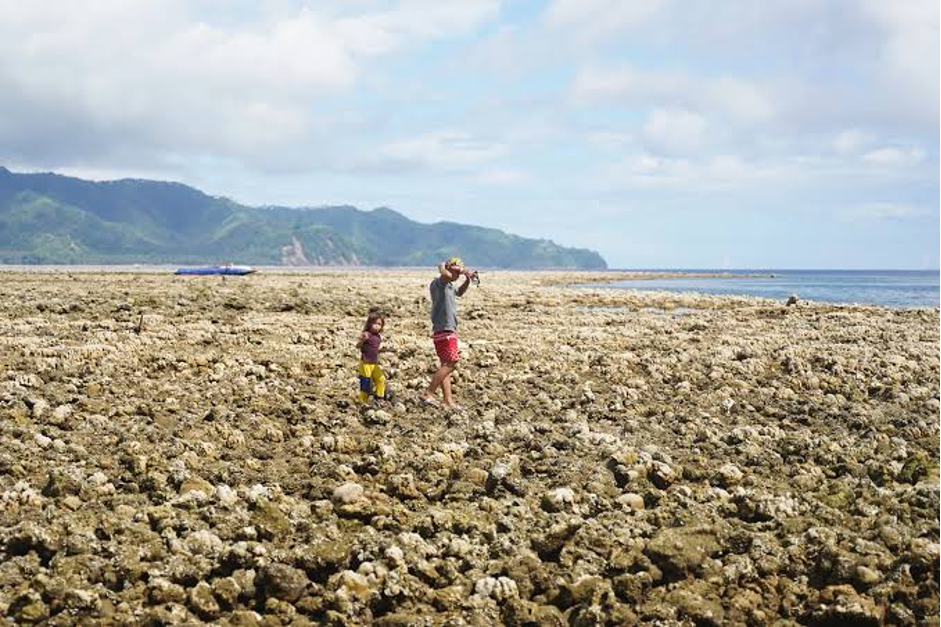
Residents walk across a newly exposed shoreline after coastal uplift (Photo Credit: Ferdinandh Cabrera)
Boat launching areas may be relocated to deeper water, with new footpaths or ramps connecting them to the village. Fishermen gradually identify productive fishing grounds that have shifted following the earthquake, while local governments may designate safer locations for future marine activities.
Some residents diversify their income by combining fishing with farming, small businesses, or tourism-related activities. This helps reduce dependence on a single livelihood that may remain vulnerable to environmental changes.
Community planning also evolves. When rebuilding damaged infrastructure, local leaders often consider not only current conditions but also the possibility of future earthquakes and additional coastal changes.
Protecting Community Well-Being
Recovery from coastal uplift extends beyond repairing buildings and restoring livelihoods. Supporting community well-being is equally important.
Families dealing with income loss may need financial assistance or alternative employment opportunities while fisheries recover. Access to healthcare, education, and social services helps reduce additional hardships during the recovery period.
Children may require stable school environments despite disruptions caused by damaged transportation routes or temporary relocation. Older adults and individuals with disabilities may face greater challenges navigating newly altered terrain, making accessible infrastructure an important part of rebuilding efforts.
Mental well-being should also be considered. Experiencing a major earthquake followed by dramatic environmental changes can create lasting stress and anxiety. Community support networks, local organizations, and public services all contribute to helping residents regain a sense of normalcy.
What Indonesia Can Learn from Mindanao’s Experience
The challenges faced by coastal communities in Mindanao are not unique to the Philippines. Indonesia shares many of the same geological characteristics as its neighboring country, with both nations located along the Pacific Ring of Fire—one of the world’s most tectonically active regions. As an archipelagic nation with thousands of coastal villages that rely on fishing, marine transportation, aquaculture, and tourism, Indonesia could face similar long-term consequences if major earthquakes trigger coastal uplift.
Indonesia has experienced significant tectonic events before. The 2004 Aceh earthquake and tsunami permanently reshaped sections of the coastline, while the 2018 Sulawesi earthquake caused coastal deformation in several areas. Although each disaster unfolded differently, these events demonstrate that earthquakes can alter coastlines in ways that continue affecting communities long after emergency response efforts have ended.
Mindanao’s experience highlights the importance of preparing not only for the earthquake itself but also for permanent environmental changes that may follow. Recovery plans should account for the possibility that fishing ports, boat ramps, coastal roads, and traditional fishing grounds may no longer be suitable after the shoreline shifts. Rebuilding infrastructure based solely on pre-earthquake conditions could create new challenges if the coastline has permanently changed.
The experience also emphasizes the need to support fishing communities beyond immediate disaster relief. Many Indonesian fishermen operate on a small scale and have limited financial resources, making it difficult to relocate operations, purchase larger boats, or travel farther offshore if fish habitats shift. Financial assistance, alternative livelihood programs, and technical support can help communities adapt while marine ecosystems gradually recover.
Another valuable lesson is the importance of regularly updating hazard maps and coastal surveys after major earthquakes. Scientific assessments of newly altered coastlines can guide safer reconstruction, helping local governments determine where to rebuild ports, roads, and community facilities while reducing future risks.
Perhaps most importantly, Mindanao demonstrates that resilience is about more than restoring what existed before. In some cases, communities must learn to live with an entirely different coastline. By studying the experiences of neighboring countries like the Philippines, Indonesia can strengthen disaster preparedness, improve long-term recovery planning, and better protect the livelihoods of millions of people who depend on healthy and accessible coastal environments.
Preparing for the Future
For communities living in tectonically active regions like Mindanao, coastal uplift highlights the importance of long-term preparedness.
Residents increasingly benefit from community education about earthquake hazards, evacuation procedures, and coastal changes. Local governments can support preparedness by updating hazard maps, improving emergency communication systems, and involving residents in disaster planning.
Building stronger partnerships between communities, scientists, engineers, and disaster management agencies also helps ensure that future recovery efforts are based on both local knowledge and scientific understanding.
As coastal communities continue adapting to their transformed shorelines, their experiences demonstrate the importance of resilience, cooperation, and flexible planning in responding to permanent environmental change.