

Eel Migration: A Mysterious Coastal Journey
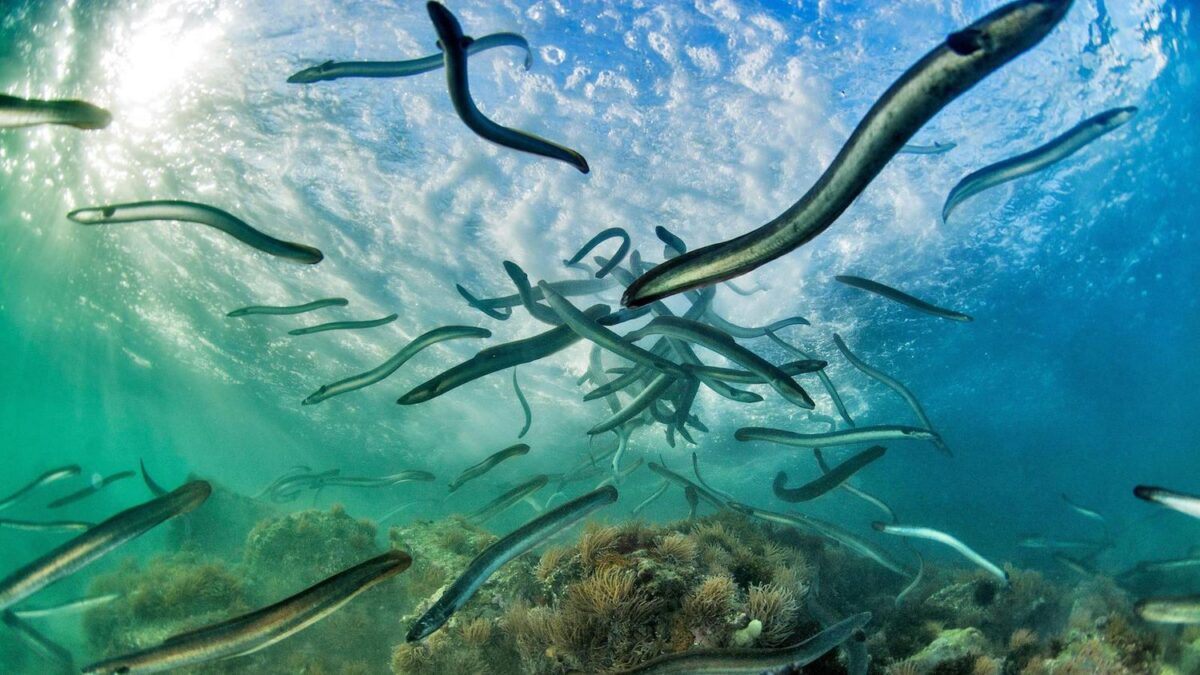
European eels in the Port of Sete, France (Photo Credit : Mathieu Folquie/Biosphoto/Minden Pictures)
A fish spends its growing phase living in a river, tucked among the roots of riparian vegetation, on muddy riverbeds, or in the calm waters upstream.
During its life phase, a body transformation occurs: its body color turns darker, its eyes enlarge, its digestive tract undergoes changes, and its body prepares for a long journey to the sea.
The fish then leaves the river—not heading toward an estuary to feed, but out to the open sea, perhaps traveling thousands of kilometers to reach a spawning ground located far in the middle of the ocean.
This fish is the freshwater eel (Anguilla spp.). Behind its long, snake-like body, the eel harbors one of the most intriguing migration stories in aquatic ecology. Its life cycle connects the open ocean, estuaries, rivers, and the sea once more.
In European eels (Anguilla anguilla), adults can travel around 5,000–10,000 km across the Atlantic to the Sargasso Sea region. Research using satellite tags has provided direct evidence that adult eels can reach the area long suspected for nearly a century to be their spawning ground.
A very simple question with an extraordinarily complex answer is: how does an eel find its way to its spawning ground in the middle of the ocean?
Eels are not merely river fish; they belong to a group of fish in the genus Anguilla that possess a catadromous life cycle. This term means that most of their growth phase takes place in continental waters—such as rivers, lakes, swamps, or estuaries—while reproduction occurs at sea.
Their life cycle begins in the ocean. After spawning, the eggs hatch into flat, transparent larvae called leptocephali. These larvae are carried by ocean currents toward coastal areas.
As they approach the coast, the larvae undergo metamorphosis into glass eels, maintaining a transparent body. Glass eels then enter estuaries and migrate upstream into rivers.
In this habitat, the eel enters the yellow eel phase—a growth period that can last for years.
Upon reaching maturity, its body changes once again. Its color turns silvery, and its physiological systems prepare for the journey back to the ocean. This stage is known as the silver eel phase, signaling the start of the return journey to the sea.
Eel Life Cycle Diagram
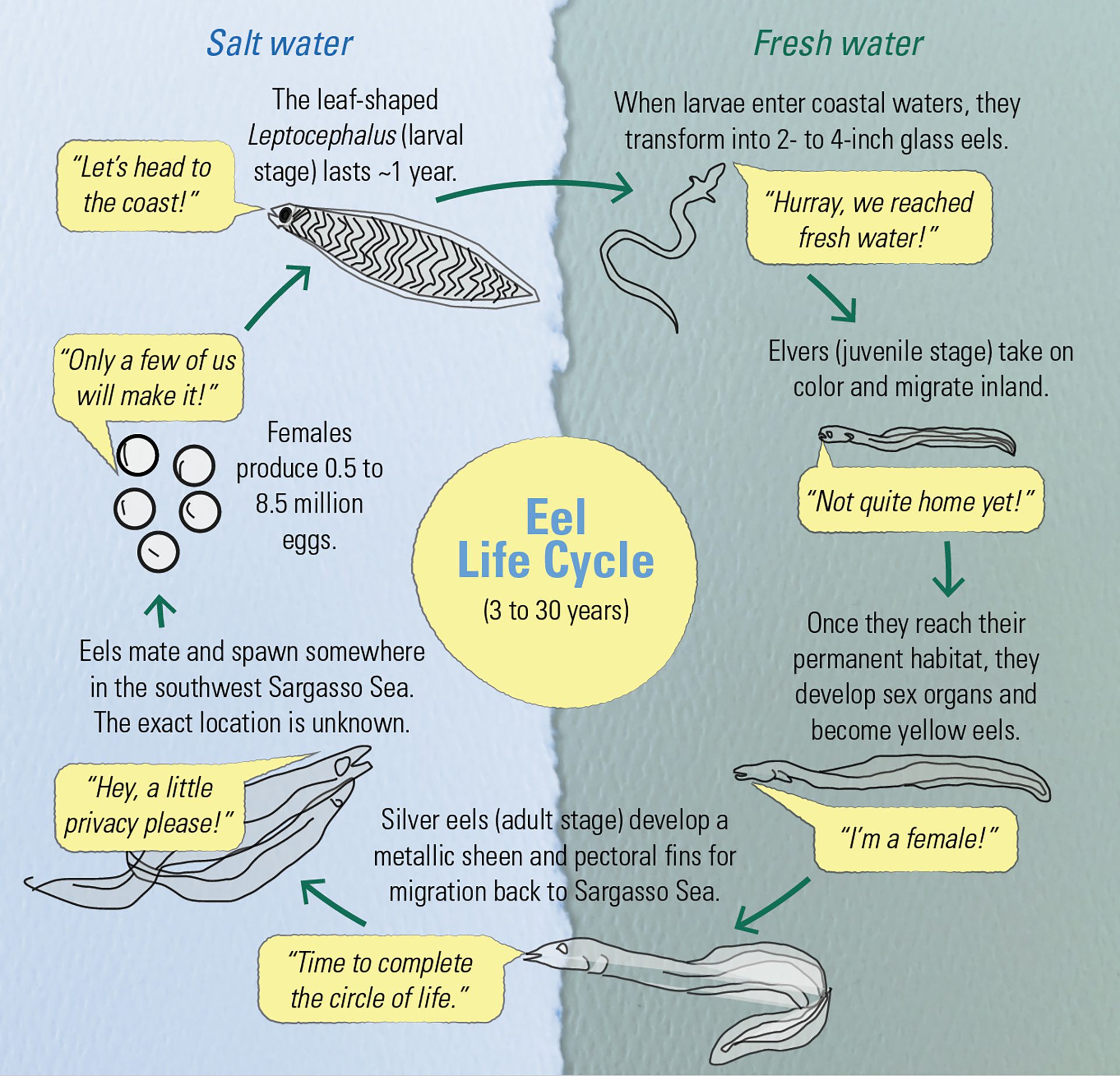
Eel life cycle (Photo Credit : Woods Hole Oceanographic Institution)
A single ecosystem never stands alone in the life of an eel. The river is part of its oceanic journey, the estuary is its connecting gateway, and the sea is both its destination and an essential origin point for the next generation.
Meet 5 Migratory Eels
The genus Anguilla consists of various species with broad geographical distributions. The following five species help illustrate the diverse migratory journeys across different oceans.
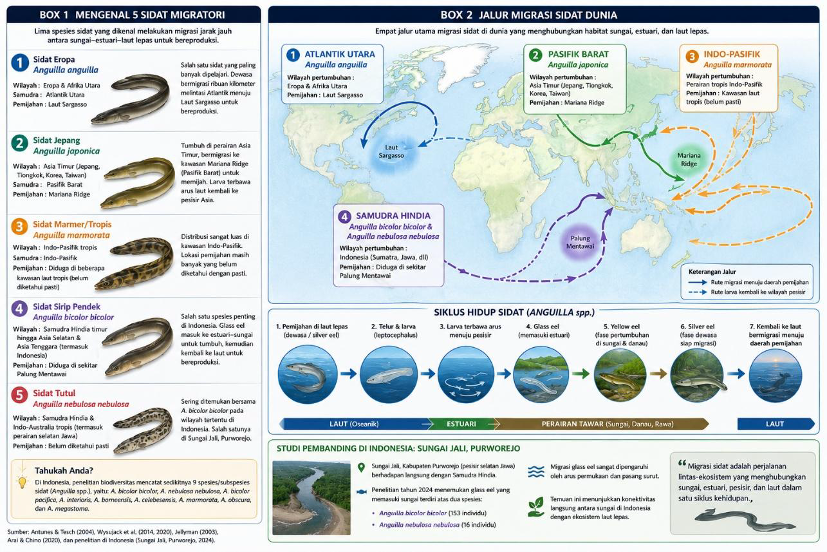
Migratory eel diagram (Photo Credit : Antunes & Tesch (2004), Wysujack et al. (2014, 2020), Jellyman (2003), Arai & Chino (2020) and penelitian di Indonesia (Sungai Jali, Purworejo, 2024))
- European Eel (Anguilla anguilla)
Growth Region: Europe and North Africa
Ocean: North Atlantic
Spawning Area: Sargasso Sea
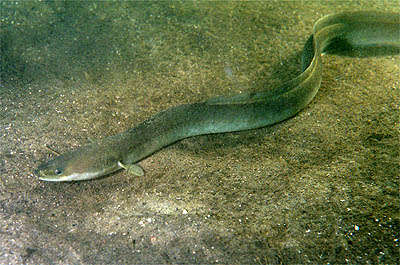
European eel (Photo Credit : GerardM)
The European eel is one of the most intensively studied eel species. Adults leave European rivers and coastal waters to undertake a long journey into the Atlantic. Satellite tagging shows that the trek to the Sargasso Sea can cover thousands of kilometers. In a study in the Azores, 26 eels were fitted with satellite tags, and several individuals were successfully tracked toward the long-presumed spawning region.
- Japanese Eel (Anguilla japonica)
Growth Region: Japan, Korea, China, Taiwan, and East Asian regions
Ocean: West Pacific
Spawning Area: Around the West Mariana Ridge
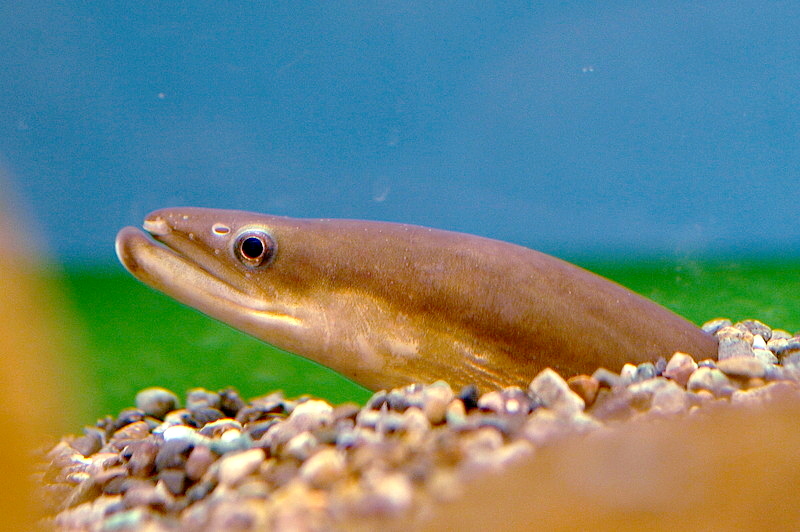
Japanese eel (Photo Credit : opencage)
The Japanese eel represents a remarkable example of transoceanic migration. Research indicates that this species spawns near the West Mariana Ridge within the North Equatorial Current system. Eggs and early larvae have been found in this area, while ocean currents subsequently help transport the larvae to recruitment areas in East Asia.
- Marbled Eel (Anguilla marmorata)
Growth Region: Indo-Pacific (rivers, estuaries, and tropical coastal waters)
Ocean: Indo-Pacific
Spawning Area: Tropical ocean areas (exact locations remain unconfirmed)
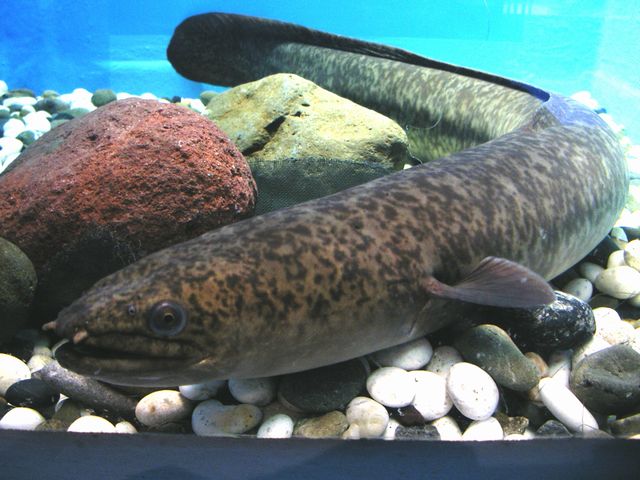
Marbled eel (Photo Credit : ふうけ)
Anguilla marmorata has a vast distribution area across the Indo-Pacific. Unlike A. japonica, our understanding of its full migratory routes and exact spawning grounds is not as robust. However, satellite tagging studies have demonstrated that individual A. marmorata can perform long oceanic journeys to spawning areas, showing that tropical eels are also key open-ocean navigators.
- Shortfin Eel (Anguilla bicolor bicolor)
Growth Region: Eastern Indian Ocean and Southeast Asia (including Java and Sumatra, Indonesia)
Ocean: Indian Ocean
Spawning Area: Suspected to be near the Mentawai Trench
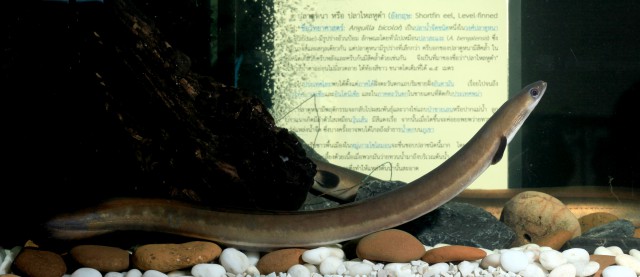
Indonesian shortfin eel (Photo Credit : BEDO)
bicolor bicolor glass eels enter estuaries and move upstream into rivers to grow. Upon reaching maturity, adults return to the ocean to reproduce. Thus, the presence of A. bicolor bicolor in Indonesian rivers is an integral part of a life cycle connected directly to the Indian Ocean.
- Indian Longfin Eel (Anguilla nebulosa nebulosa)
Growth Region: Tropical Indian Ocean and Indo-Australia (including the southern coast of Java, Indonesia)
Ocean: Indian Ocean
Spawning Area: Exact location unconfirmed
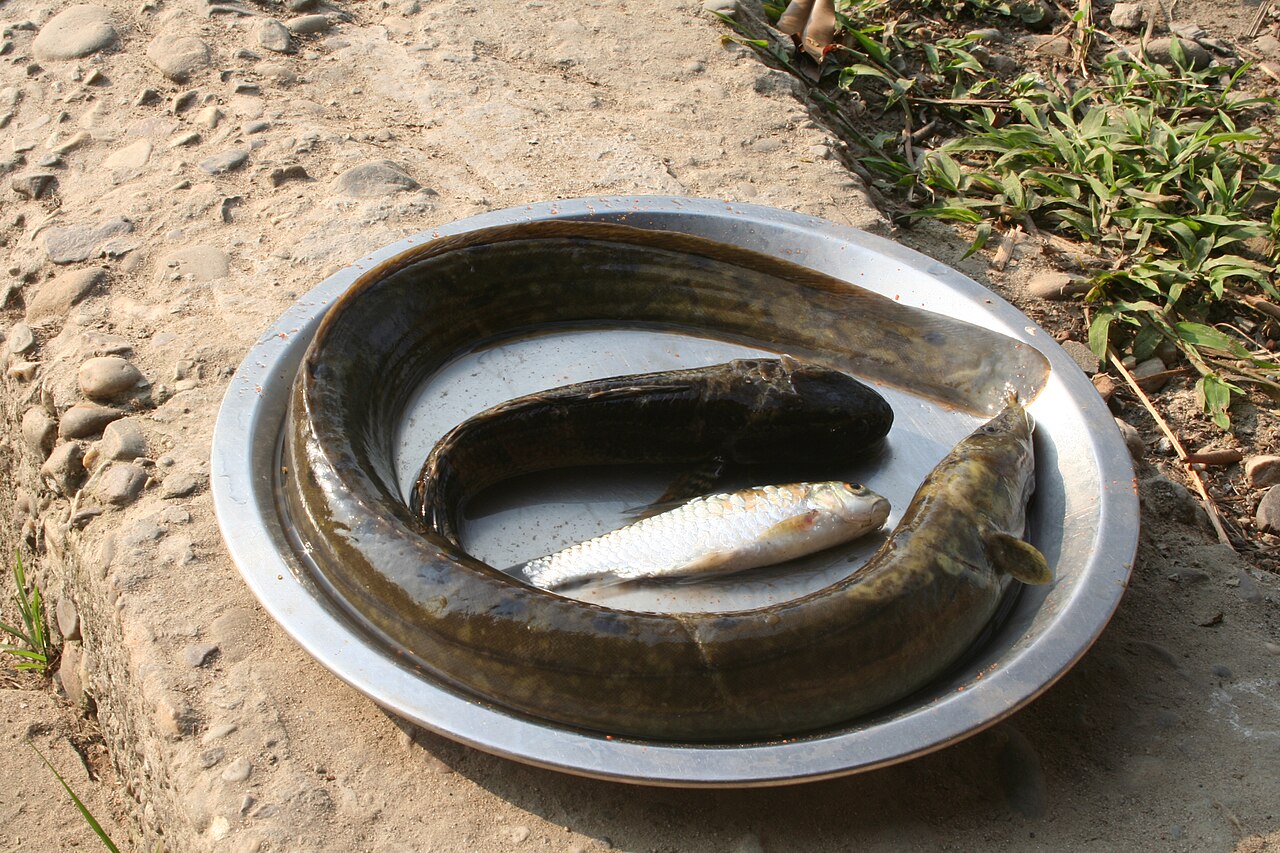
Indian longfin eel (Photo Credit : Nandini Velho at Pakke Tiger Reserve)
This species is often found alongside A. bicolor bicolor in several Indonesian rivers. Research at the Jali River in Purworejo found both species entering the river as glass eels. Out of 169 identified individuals, 153 were A. bicolor bicolor and 16 were A. nebulosa nebulosa.
Global Eel Migration Routes
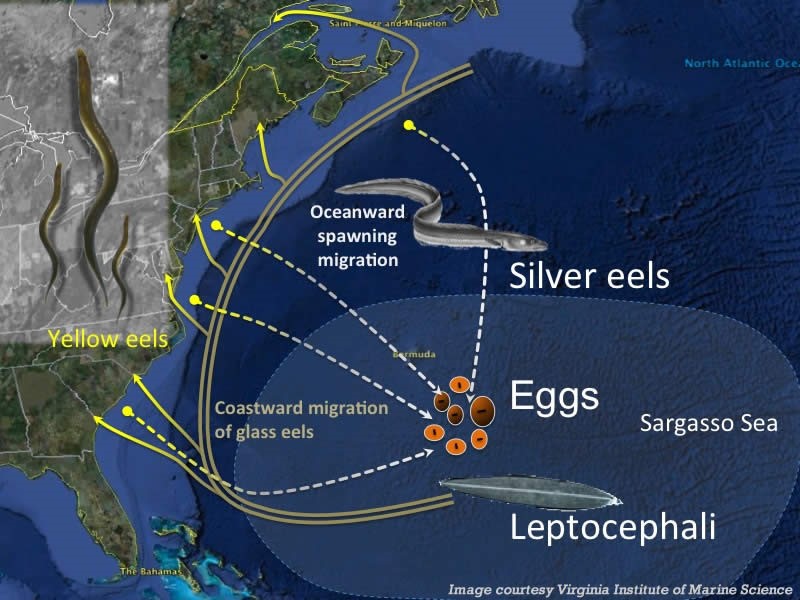
American eel migration route (Photo Credit : Virginia Institute of Marine Science)
Looking at the map, eel journeys appear distinct from one species to another. Yet, a universal pattern holds true:
Sea->Coast->River->Coast->Sea
In European eels, this path connects European rivers with the Atlantic and the Sargasso Sea.
In Japanese eels, it links East Asian waters with the West Mariana Ridge in the West Pacific, where larvae are carried by the North Equatorial Current and Kuroshio system back to Asian recruitment zones.
Meanwhile, tropical species like A. marmorata and A. bicolor bicolor demonstrate the migration complexity within the Indo-Pacific.
Consequently, a coastline that looks like a simple land boundary is actually part of a vast ecological network.
The Greatest Mystery
How Do Eels Find Their Way?
River migration is relatively easy to visualize: there is water flow, riverbanks, and landscape features to serve as landmarks. But what about the open sea? There are no roads, no street signs, and no shorelines to guide the way. Yet, silver eels reliably navigate thousands of kilometers.
Scientists suspect eels use a combination of environmental cues, including the Earth's magnetic field, ocean currents, temperature, salinity, as well as chemical and olfactory signals. The complete navigation mechanism remains incompletely understood.
For the Japanese eel, oceanographic and geological features form part of the spawning environment itself. The West Mariana Ridge provides a seamount structure linked to spawning sites, while salinity fronts are believed to help dictate latitude coordinates for spawning. In short: eels do not migrate through an empty sea. They navigate a dynamic three-dimensional landscape defined by currents, temperature, salinity, depth, seafloor structures, and magnetic fields.
From Ocean to River: Lessons from the Jali River, Purworejo
This global phenomenon can be observed up close in Indonesia. A prime example is the Jali River in Purworejo Regency, located on the southern coast of Java emptying into the Indian Ocean.
Research on glass eels in this river shows that juveniles move from the ocean into the estuary and push into freshwater. Studies conducted during the new moon phase identified two species (Anguilla bicolor bicolor and Anguilla nebulosa nebulosa). Out of 169 identified glass eels:
Anguilla bicolor bicolor: 153 individuals (~91%)
Anguilla nebulosa nebulosa: 16 individuals (~9%)
Interestingly, this glass eel migration is tightly linked to surface currents and tides. The research also highlights that osmoregulatory capacity is essential when transitioning from seawater to freshwater. The findings from the Jali River offer a clear takeaway: the global journey of eels starts and ends in places right in our backyard.
When Estuaries Are Blocked, the Journey Ends
The story of the eel is a stark reminder of the critical importance of coastal connectivity. Consider a river dammed without a fish ladder, a severely degraded estuary, or coastal waters polluted by human activity.
To humans, these environmental changes might seem like isolated local issues; to eels, the impacts are catastrophic. A barrier in a river stops the growth phase. Estuarine degradation blocks glass eel recruitment. Changes in ocean conditions disrupt larval drift or silver eel migration.
In short, disrupting one link breaks the entire life cycle. This is why eel conservation cannot succeed by protecting rivers or oceans in isolation. We must safeguard the entire ecological corridor.
Eels as "Ambassadors of Ecosystem Connectivity"
The essential message carried by the eel's journey is clear: rivers are not separate from oceans; estuaries are not just mixing zones for fresh and salt water; coastlines are not the edge of the land.
For migratory organisms, these habitats form a single continuous system. Eels embody this concept perfectly. A glass eel entering an Indonesian river carries stories of the open ocean. A yellow eel growing in a river is preparing to return to the sea. And a silver eel leaving the river embarks on a reproductive voyage across thousands of ocean kilometers. Protecting eels means preserving ecological connectivity from upstream waters all the way to the open ocean.
Unsolved Secrets
Advances in technology have transformed how we study eels. Satellite tagging allows researchers to track portions of their ocean treks, oceanographic modeling predicts likely routes, DNA analysis distinguishes morphologically similar species, and larval research helps pinpoint spawning zones. Yet many core questions remain open:
- How do eels choose their directional heading?
- How do they pinpoint exact spawning sites?
- How do river-reared individuals recognize the path to the sea?
- How will climate-driven changes in ocean currents impact larval drift?
- How will rising sea temperatures affect reproductive success?
These questions position the eel not merely as an object of fish ecology, but as an active subject across oceanography, physiology, animal behavior, navigation, climate science, and ecosystem connectivity.
We learn about the ocean through the eel. An eel may look simple—long-bodied, slow-moving on a riverbed, and lacking the bright colors of reef fish. Yet behind that simple appearance lies one of the planet's most astonishing biological journeys. An eel grows in a river, navigates an estuary, and crosses oceans to reproduce, leaving the next generation to repeat the cycle across thousands of kilometers.
When we spot an eel in a river, we are looking at far more than just a fish: we are glimpsing a small chapter of an epic oceanic odyssey connecting rivers to coasts, coasts to oceans, and one generation to the next. Eel migration is more than a story about fish movement; it is a story about the interconnectedness of life on a planet covered mostly by water.
-Yuni Sulaiman
References
Aoyama, J., Watanabe, S., Miller, M. J., Mochioka, N., Otake, T., Yoshinaga, T., & Tsukamoto, K. (2014). Spawning sites of the Japanese eel in relation to oceanographic structure and the West Mariana Ridge. PLoS ONE, 9(2), e88759.
Indrawati, et al. (2024). Species composition and inshore migration of the tropical glass eels (Anguilla spp.) recruiting to the Jali River, Purworejo Regency. Journal of Tropical Biodiversity and Biotechnology, 9.
Wright, R. M., et al. (2022). First direct evidence of adult European eels migrating to their breeding place in the Sargasso Sea. Scientific Reports.
Tsukamoto, K. (2009). Oceanic migration and spawning of anguillid eels. Journal of Fish Biology.
Chen, S.-C., Chang, C.-R., & Han, Y.-S. (2018). Seaward migration routes of indigenous eels, Anguilla japonica, A. marmorata, and A. bicolor pacifica, via satellite tags. Zoological Studies, 57, 21.