

Bobtail Squid: Tiny Masters of Nighttime Camouflage
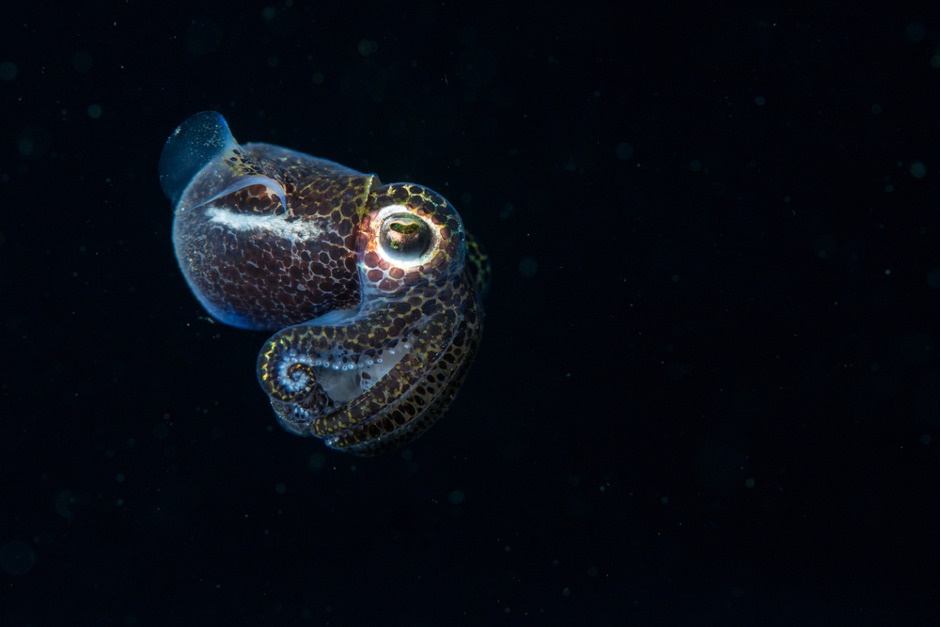
A close-up of a bobtail squid at night (Photo Credit : Padi.com)
The ocean is home to countless remarkable creatures, but few are as fascinating as the bobtail squid. Despite their name, these animals are not true squids. Instead, they belong to a separate group of cephalopods that share characteristics with both squids and cuttlefish. Measuring only a few centimeters in length, bobtail squids have evolved extraordinary adaptations that help them survive in shallow coastal waters where predators lurk both above and below.
A Small Cephalopod with a Unique Appearance
Bobtail squids are recognized by their rounded bodies, short arms, and large, expressive eyes. Unlike the elongated bodies of typical squids, they have a compact, almost spherical shape that gives them a charming appearance. Their fins are relatively large compared to their body size, allowing them to hover and maneuver with impressive precision.
Berry’s bobtail squid (Photo Credit : diverosa)
These tiny cephalopods are commonly found in tropical and temperate coastal waters around the world. They inhabit sandy seabeds, seagrass meadows, shallow lagoons, and sheltered bays, where soft sediments provide ideal conditions for burrowing and hiding. During the day, they spend much of their time buried beneath sand or soft sediment, emerging only after sunset to hunt for small shrimp, worms, and other tiny marine organisms.
Masters of Counter-Illumination
One of the bobtail squid’s most remarkable survival strategies is its ability to camouflage itself using light. At night, predators swimming below can often detect prey by spotting dark silhouettes against the faint moonlight filtering through the water’s surface.
To solve this problem, bobtail squids perform a technique known as counter-illumination. Instead of remaining dark, they produce light from the underside of their bodies, matching the brightness of the moonlight above. This effectively erases their silhouette, making them nearly invisible to predators looking upward.
The squid carefully adjusts the intensity of this glow depending on the surrounding light conditions, allowing it to blend seamlessly into the nighttime environment.
A Remarkable Partnership with Bioluminescent Bacteria
Unlike many glowing marine animals that produce their own light chemically, bobtail squids rely on microscopic partners. They house bioluminescent bacteria inside a specialized light organ located beneath their bodies.
These bacteria, commonly from the genus Aliivibrio (formerly classified as Vibrio), naturally emit blue-green light. The squid provides the bacteria with nutrients and a protected habitat, while the bacteria provide continuous illumination for camouflage. This mutually beneficial relationship is one of the best-known examples of symbiosis in marine biology.
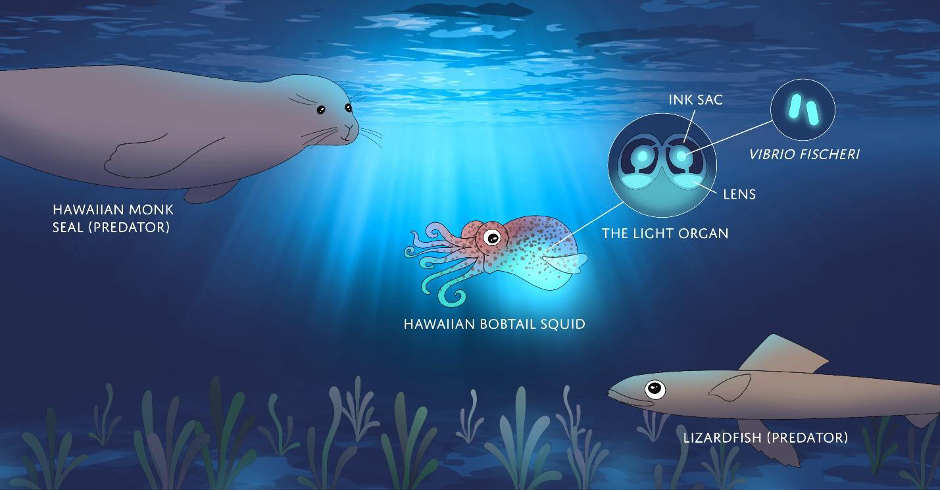
An illustration of the bobtail squid’s relationship with glowing bacteria (Photo Credit : labxchange)
Every morning, the squid expels a large portion of the bacterial population before burying itself in the sand. Throughout the day, the remaining bacteria multiply, restoring the colony so it is ready to produce light again when night falls.
Precision Light Control
The light organ is far more sophisticated than a simple glowing pouch. It contains reflective tissues, filters, and structures that function much like lenses and mirrors. These features allow the squid to direct and soften the bacterial light, ensuring it closely matches the surrounding environment.
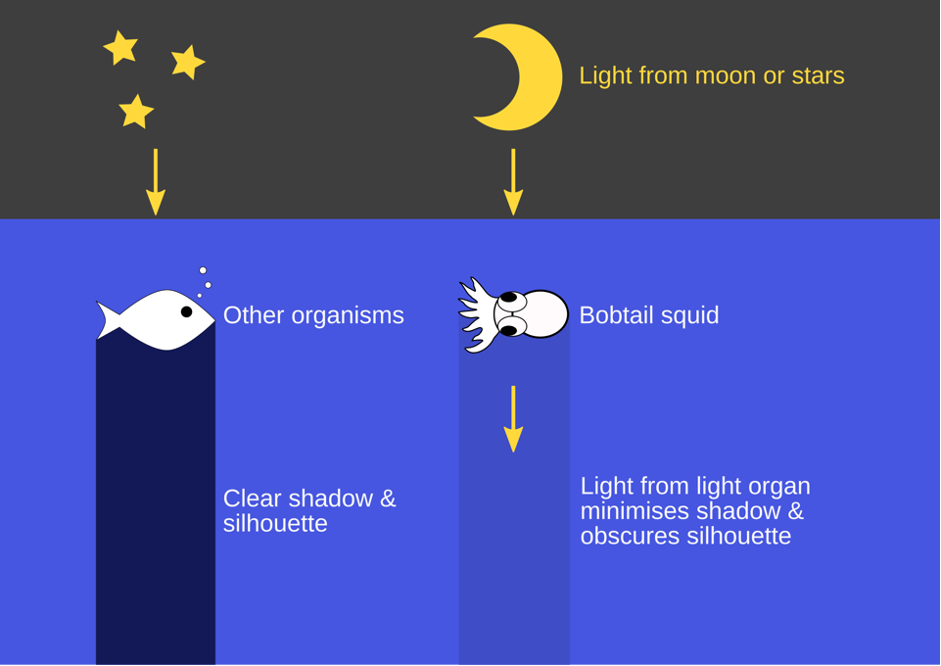
Diagram of how bobtail squids utilise their light organs to obscure their silhouettes (Photo Credit : Pen-Yuan Hsing)
Special pigments and adjustable tissues also help regulate how much light escapes. By fine-tuning the brightness, the squid can adapt to changing moon phases, cloud cover, and water clarity, making its camouflage remarkably effective.
Nighttime Hunters
Although they are experts at hiding, bobtail squids are also efficient predators. They emerge after dark to search for small crustaceans and other invertebrates. Their excellent vision, combined with rapid bursts of jet propulsion, allows them to ambush prey with surprising speed.
Like other cephalopods, they possess sharp beaks capable of breaking apart the hard shells of tiny crustaceans. Their tentacles quickly grasp prey before bringing it toward the mouth for consumption.
After feeding, the squid often returns to sandy areas where it can quickly disappear beneath the sediment if danger approaches.
Burrowing for Protection
During daylight hours, bobtail squids remain vulnerable to numerous predators, including larger fish and seabirds. To reduce this risk, they use their fins and jets of water to bury themselves beneath the sand, leaving only their eyes exposed to monitor their surroundings.
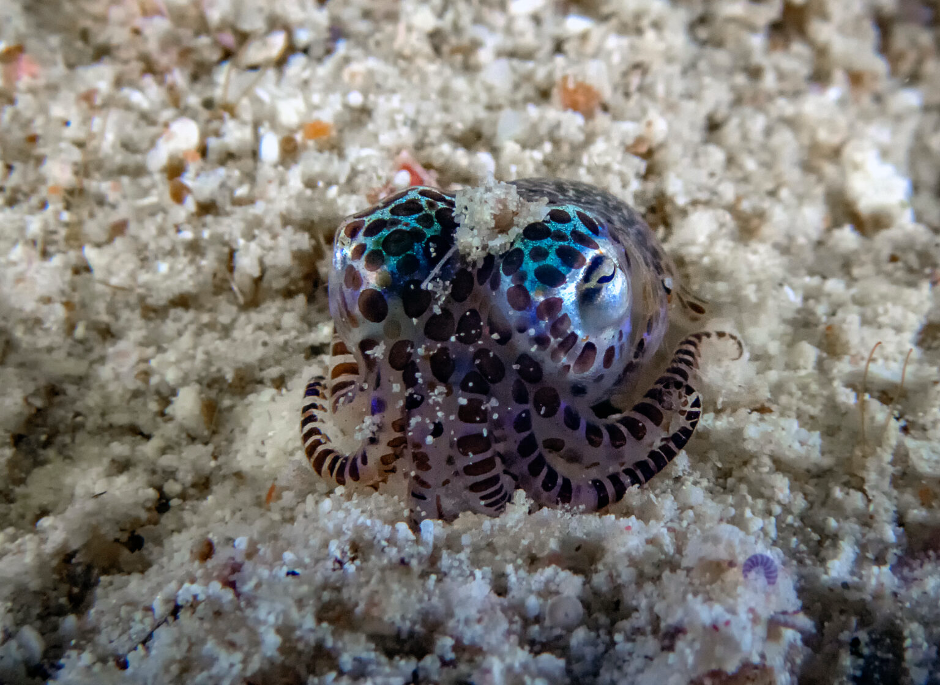
Bobtail squid daytime behavior of burying itself in the sand (Photo Credit : American Oceans)
This behavior provides excellent protection while conserving energy. The sandy covering also helps regulate body temperature and shields the squid from strong currents and waves in shallow coastal habitats.
Rapid Growth and a Short Lifespan
Bobtail squids grow quickly and typically live for only about one year. Their brief lifespan reflects a common life strategy among many cephalopods, emphasizing rapid growth, early reproduction, and high reproductive output.
Females lay small clusters of eggs attached to shells, rocks, or other protected surfaces. Once the eggs hatch, the young are miniature versions of the adults and must immediately fend for themselves. Shortly after hatching, juvenile bobtail squids acquire their beneficial bioluminescent bacteria from the surrounding seawater, beginning the symbiotic partnership that will support them throughout their lives.
An Important Part of Coastal Marine Ecosystems
Although bobtail squids are small, they play an important role in maintaining the balance of coastal marine ecosystems. They occupy a middle position in the food web, serving as both predators and prey. By feeding on small crustaceans, worms, and other invertebrates, they help regulate populations of these organisms and contribute to the ecological balance of shallow seabeds.
At the same time, bobtail squids provide a valuable food source for larger marine animals, including fish, rays, octopuses, and seabirds. Their presence supports a diverse range of predators, making them an essential link in the transfer of energy through coastal food chains.
Bobtail squids are also closely associated with sandy and seagrass habitats, where they spend much of their lives buried beneath the sediment during the day. Healthy seafloor environments provide shelter from predators, suitable hunting grounds, and safe locations for laying eggs. As a result, the abundance of bobtail squids can reflect the overall condition of these coastal ecosystems.
Like many marine species that inhabit shallow waters, bobtail squids face increasing pressure from human activities. Coastal development, pollution, declining water quality, and damage to seagrass meadows can reduce the availability of suitable habitats. Artificial lighting near shorelines may also alter the natural darkness that these nocturnal animals rely on for hunting and camouflage, potentially affecting their behavior and survival.
Protecting coastal habitats not only benefits bobtail squids but also supports the countless other species that depend on these productive ecosystems. Conserving sandy seabeds, maintaining clean coastal waters, and preserving seagrass habitats help ensure that these tiny masters of camouflage continue to thrive as part of the rich biodiversity found along the world’s coastlines.
Valuable to Scientific Research
The relationship between bobtail squids and their glowing bacterial partners has become an important model for scientific research. Because the interaction is relatively simple and highly specialized, researchers use it to better understand how beneficial microbes establish long-term relationships with animal hosts.
Studies of bobtail squids have contributed to broader knowledge about immune systems, microbial communication, animal development, and host-microbe interactions. Insights gained from this tiny marine animal have influenced research in fields ranging from microbiology to human health, demonstrating how even the smallest ocean creatures can provide valuable scientific discoveries.
More Than Just a Tiny Squid
Although easily overlooked because of their small size, bobtail squids possess an extraordinary combination of adaptations. Their partnership with glowing bacteria, sophisticated light-control system, nocturnal hunting behavior, and ability to vanish into both light and sand make them one of the ocean’s most remarkable examples of evolutionary innovation.
Their success is closely tied to the health of coastal environments, where sandy seabeds and seagrass meadows provide shelter, hunting grounds, and breeding sites. By thriving in these habitats and contributing to the balance of coastal food webs, bobtail squids demonstrate how even the smallest marine animals can have a significant ecological impact.
From their remarkable camouflage to their unique partnership with bioluminescent bacteria, bobtail squids showcase the incredible diversity and ingenuity of life beneath the waves, proving that some of nature’s most impressive survival strategies come in surprisingly small packages.