

Mantis Shrimp: A Colorful Predator with a Deadly Punch
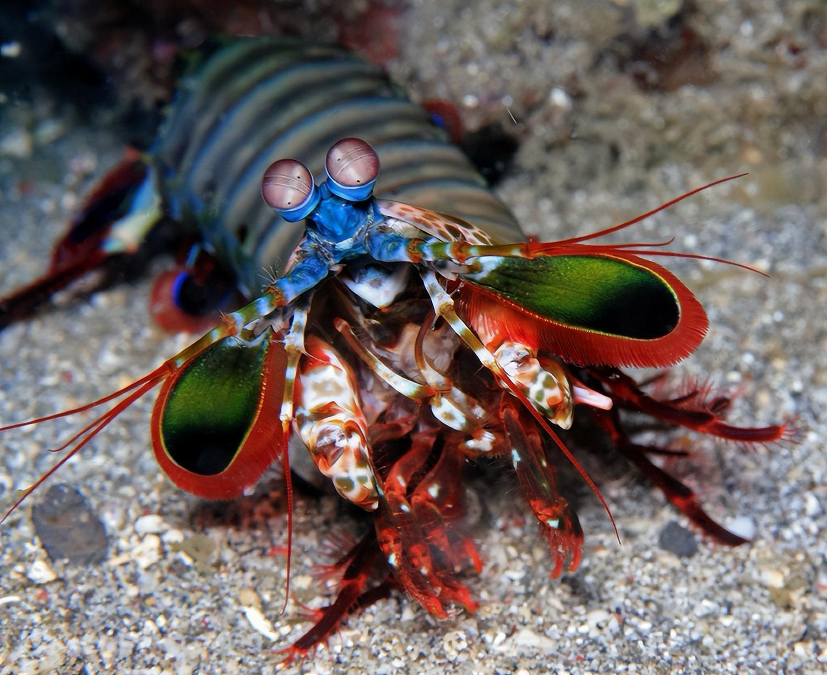
Colorful mantis shrimp (Photo Credit : Johnandersonphoto/iStock)
Get to know stomatopods, small marine predators with incredible eyes and high-speed biological weapons
Between the coral reefs and the bottom of the tropical shallow waters, there is a predator that looks like a mixture of shrimp, praying mantis, and creatures from a science fiction movie.
Its body is colorful. Its eyes can move independently. And one part of its body is able to shoot at such a high speed that it produces cavitation bubbles in the water.
The animal is mantis shrimp, a group of marine crustaceans of the order Stomatopoda, which in Indonesian is often called mantis shrimp or stomatopoda.
Mantis shrimp are not true shrimp like the common penaeid shrimp we know. They are a group of crustaceans that have their own evolutionary history and body shape. Today, stomatopods are known as one of the most interesting groups of marine predators to study—not only because of their punching power, but also because of their highly unusual visual system and behavioral adaptations.
Who exactly is a mantis shrimp?
The name "mantis shrimp" comes from the shape of a pair of appendages on the front of its body that resemble the front legs of a praying mantis.
Taxonomically, mantis shrimp include:
Filum: Arthropoda
Subfilum: Crustacea
Grade: Malacostraca
Order: Stomatopoda
They are benthic predators that are found in tropical and subtropical regions. Most live in shallow ocean waters, especially around coral reefs, rubble, sand, mud, and substrate crevices.
In Indonesia, this group has a fairly high diversity. The literature that summarizes the existence of Indonesian stomatopods even records more than 100 species from various aquatic habitats. One example is Miyakella nepa, which has been reported from Sulawesi waters.
They generally spend a lot of time inside burrows or crevices of shelter, then go out to hunt or interact with other individuals. However, not all mantis shrimp hunt in the same way.
Two Guns, Two Hunting Strategies
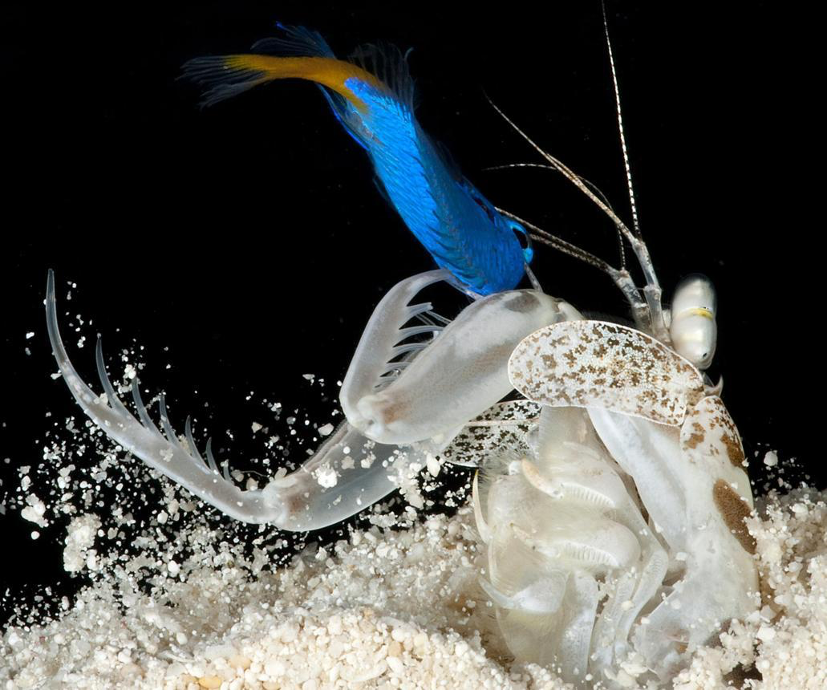
A spearing mantis shrimp just after capturing a prey fish (Photo Credit : Roy Caldwell/UC Berkeley)
One of the most interesting characteristics of stomatopods is the presence of two main types of predatory appendages:
- Smasher
This type has an appendage with a hammer-like tip. They are used to hit hard-shelled prey such as mollusks and other crustaceans. One of the most famous species is the peacock mantis shrimp (Odontodactylus scyllarus).
- Spearer
Different from smashers, this type has a sleeker and more prickly appendage. Appendages are used to stab or catch moving prey, including small fish and a variety of other organisms. Thus, the term "mantis shrimp stroke" does not actually apply to all stomatopods with the same mechanism.
The shape of the appendage reflects different predation strategies, an interesting example of how evolution can result in modifications of the structure of the body according to its ecological function.
A Punch That Is More Than Just a Punch
This is the part that makes the mantis shrimp famous. In the smasher species, the energy to attack is not generated only from direct muscle contraction. Some of the energy is first stored in the elastic structure of the exoskeleton, then released very quickly through a mechanism such as a spring.
In Odontodactylus scyllarus, the predator's appendage can move at speeds of up to about 23 m/s. This very fast movement generates enough pressure to form cavitation bubbles in the water.
Cavitation occurs when the local pressure in the liquid drops to such an extent that a steam bubble is formed. When the bubble then collapses, additional energy is released around the target. So, the prey does not only face a direct impact from the biological "hammer". It can also be affected by the effects of the cavitation that accompanies such superfast movements.
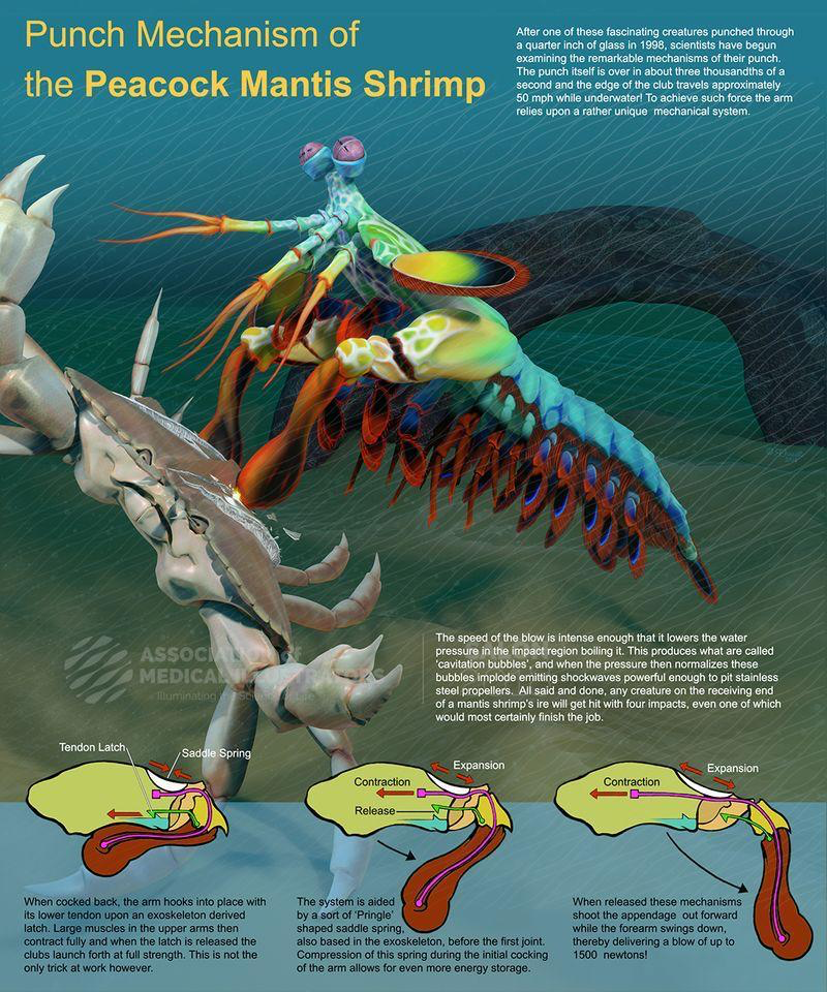
Punch mechanism of the peacock mantis shrimp (Photo Credit : AMI2018)
Quick Facts
Appendage speed: up to approx. 23 m/s
Mechanism: Elastic energy storage and release
Additional effects: Cavification
Target: especially hard-shelled prey on the type Smasher
Biomechanical research shows that this system is a latch-mediated spring actuation mechanism, which is a mechanism that allows energy to be stored first and released in a very short time.
Not only strong, but also impact-resistant
Interestingly, if the appendage of the mantis shrimp hits the hard shell many times, the structure should be damaged. But evolution has a solution. The end of the appendage called the dactyl club has a very complex material structure. The constituent material is arranged hierarchically so that it is able to withstand repeated impacts while helping to inhibit the propagation of cracks.
Biomaterials research has even made the dactyl club mantis shrimp one of the important examples in the development of impact-resistant materials inspired by nature (bio-inspired materials).
In other words, the mantis shrimp not only has a fast "hammer". It also has a hammer that is biologically designed to withstand repeated impacts.
Eyes That Seem to Come from Another World
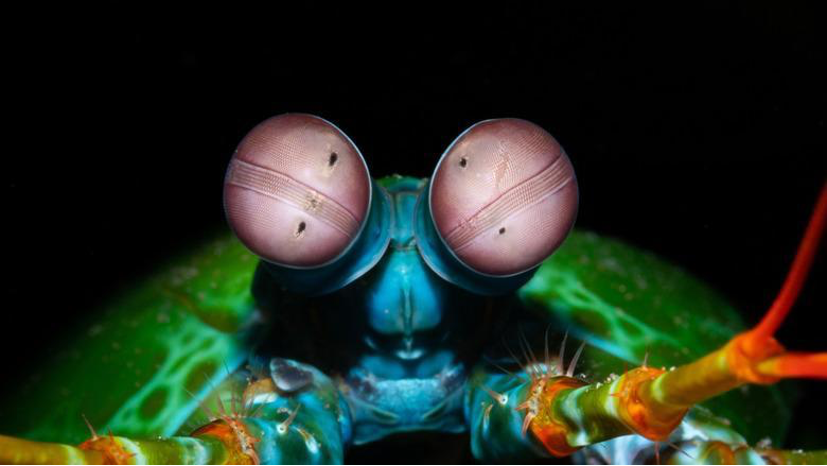
Mantis shrimp head (Photo Credit : Samy Kassem/iStock)
If the mechanical weapons are extraordinary, their visual system is no less interesting. The eyes of the mantis shrimp are compound eyes that consist of thousands of small vision units or ommatidia. However, the structure of their eyes has a special part called a midband.
In species with a six-line midband, some ommatidia rows have a special function for detecting color and other parts have to do with polarizing vision.
It is known that some stomatopods have up to 12 spectral receptor channels that are sensitive to different wavelength ranges, including ultraviolet.
But there is one thing that needs to be straightened out. Mantis shrimps are often referred to as the animals with "the best color vision in the world". That phrase oversimplifies reality. A large number of receptors does not automatically mean that they have the ability to distinguish colors with the highest precision. The visual system of stomatopods is very complex, but its ability to discriminate colors can be more limited than that of certain color vision systems in other animals.
So, the uniqueness of the mantis shrimp is not just that it "sees more color", but lies in its very different visual system architecture.
They can even see the polarization of light
One of the most interesting abilities of stomatopods is the ability to detect polarized light. Light entering the marine environment can undergo polarization changes due to interactions with water, substrate surfaces, and various objects.
Some mantis shrimp have receptors capable of detecting such information. More surprisingly, their eyes can perform rotational movements to help increase the polarizing contrast of an object against the background. Research on Gonodactylus smithiiand Odontodactylus scyllarus suggests that this eye rotational movement can be actively used in polarizing vision.
Thus, the mantis shrimp's eyes are not just a "camera". They are an active sensory system that moves, scans, and adjusts their position to the visual environment.
Why Are Their Eyes So Complex?
The answer may have to do with the way they live as predators. Mantis shrimp should:
- detecting prey
- determine the distance
- recognize objects
- monitoring predators
- communicate with other individuals
- directs the predator's appendage in the right position
All of this takes place in a visually complex three-dimensional environment. Recent neuroanatomical research has also shown that the brain structures that receive the first information from the stomatopod's retina have a very distinctive organization. This complexity has to do with the different types of photoreceptors and visual processing patterns that support visual scanning behavior in these animals.
Small Predators with Large Ecological Roles
Behind their popularity as a "super-punching animal", mantis shrimp are actually part of the food web of benthic ecosystems. As predators, they help connect populations of various benthic organisms in food webs.
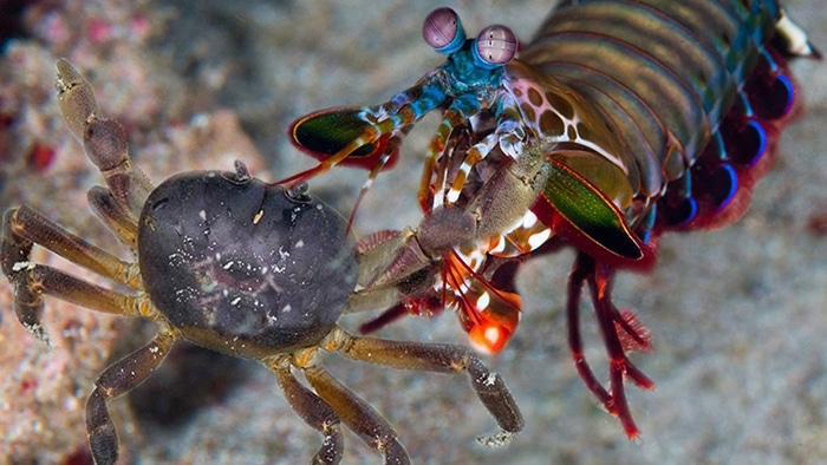
A peacock mantis shrimp using its powerful club-like appendages to strike and hunt a crab on the ocean floor (Photo Credit : fishingthai.com)
They themselves are also part of the reef ecosystem and coastal habitats in which they live. The existence of stomatopods is closely related to habitat characteristics, the availability of shelter, substrates, and food sources. In reef stomatopods, body size is also related to life history characteristics such as fecundity, larval dispersal ability, and the size of the distribution area.
Therefore, finding mantis shrimp in a habitat is not just about finding "exotic animals". Their presence is part of the picture of the biodiversity and complexity of benthic communities.
Mantis Shrimp and Coral Reefs
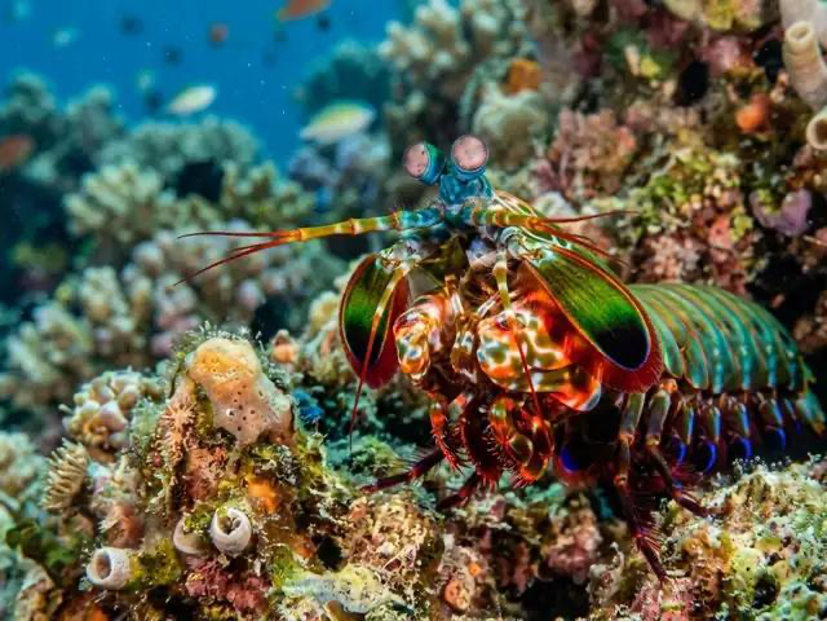
Peacock mantis shrimp (Photo Credit : The Economic Times)
Many species of stomatopods are associated with reef environments, especially areas that provide substrate to create or occupy burrows.
The reef environment provides:
Shelters → hunting sites → food sources → spaces for reproduction and social interaction
In contrast, the presence of burrowing organisms and benthic predators such as stomatopods also contributes to the ecological complexity of the habitat.
It is important to note not to consider all mantis shrimp as direct indicators of reef health. The relationship between the existence of a species and ecosystem conditions should be analyzed based on its species, habitat, abundance, and ecological context.
Not Just Predators: They Also Fight
Mantis shrimp do not always use their appendage to catch food. In some species, the same appendage is also used in agonistic interactions. One interesting behavior is telson sparring. In such interactions, individuals can attack each other's body parts called telsons, which are hard tail plates. Telsons function like shields and must be able to receive repeated attacks from other individuals.
Thus, the mantis shrimp's body exhibits two interesting evolutionary sides: weapons to attack → protective structures to survive. This is a classic example of the relationship between predation, competition, and the evolution of body structures.
What Can Humans Learn from Mantis Shrimp?
Mantis shrimp is one of the interesting examples in the field of biomimetics, which isthe science that studies biological structures and mechanisms to get inspiration for technology. Some aspects that attracted the attention of researchers include:
- Impact-resistant material: The structure of the dactyl club provides inspiration for composite materials that are able to withstand impacts and inhibit damage.
- Sensory system: The visual system of stomatopods provides insight into how organisms can combine color, ultraviolet, polarization, and movement information.
- Energy storage mechanism: The mechanism of biological springs in predatory appendages shows how energy can be stored then released in a very short period of time.
- Robotics: The principle of fast movement and spring-loaded mechanism is also attractive for the development of high-speed robotic systems.
Thus, evolution over millions of years has resulted in a biological system that is now a source of inspiration for materials science, biomechanics, robotics, and sensor technology.
Getting to Know Mantis Shrimp Closer
|
Features |
Remarks |
|
Groups |
Stomatopoda |
|
Habitat |
Seas, especially tropical and subtropical regions |
|
Lifestyle |
Bentic predators |
|
Shelter |
Burrows, rock crevices, rubble, and substrate |
|
Weapons |
Raptorial appendages |
|
Predator type |
Smasher dan spearer |
|
Attack speed |
Up to ±23 m/s in some species |
|
Uniqueness of the eyes |
Color, UV, and polarization |
|
Prey |
Diverse invertebrates and small organisms |
|
Scientific value |
Biomechanics, neurobiology, ecology, biomimetics |
Mantis Shrimp: When Evolution Turns Bodies Into Weapons
Mantis shrimp show that being a predator doesn't always mean having a big body or sharp teeth. Instead, these small animals rely on a combination of speed, biological spring mechanisms, complex visual sensors, and impact-resistant body structures.
A single quick movement of the appendage can result in impact and cavitation. Its eyes can scan the environment in unusual ways. Its body can use hard structures to protect itself when dealing with other individuals.
But perhaps the most interesting lesson of the mantis shrimp is that biodiversity produces not only beautiful shapes, but also highly complex biological solutions to life's challenges.
Behind its colorful bodies and reputation as a "super-punched shrimp", the mantis shrimp is an example of how natural selection can integrate structure, function, behavior, and environment into one highly efficient life system.
In coastal ecosystems and coral reefs, animals like these remind us that biodiversity is more than just a list of species.
Every species carries an evolutionary story—and the mantis shrimp is one of the most spectacular stories in the ocean.
-Yuni Sulaiman
References
Patek, S.N., Korff, W.L. & Caldwell, R.L. (2004). Deadly strike mechanism of a mantis shrimp. Nature, 428, 819–820. DOI: 10.1038/428819a.
Patek, S.N. & Caldwell, R.L. (2005). Extreme impact and cavitation forces of a biological hammer: strike forces of the peacock mantis shrimp. Journal of Experimental Biology, 208, 3655–3664.
Cronin, T.W. et al. (2014). Filtering and polychromatic vision in mantis shrimps. Philosophical Transactions of the Royal Society B.
How, M.J. et al. (2016). Dynamic polarization vision in mantis shrimps. Nature Communications.
Colour vision in stomatopod crustaceans (2022). Philosophical Transactions of the Royal Society B.
Wang, Z. & Marshall, N.J. (2025). Neural repertoire behind the world's most complex retina: neuroanatomy of the stomatopod lamina. Journal of Comparative Neurology