Leaf Litter to Food Web: How Fallen Mangrove Leaves Support Coastal Productivity
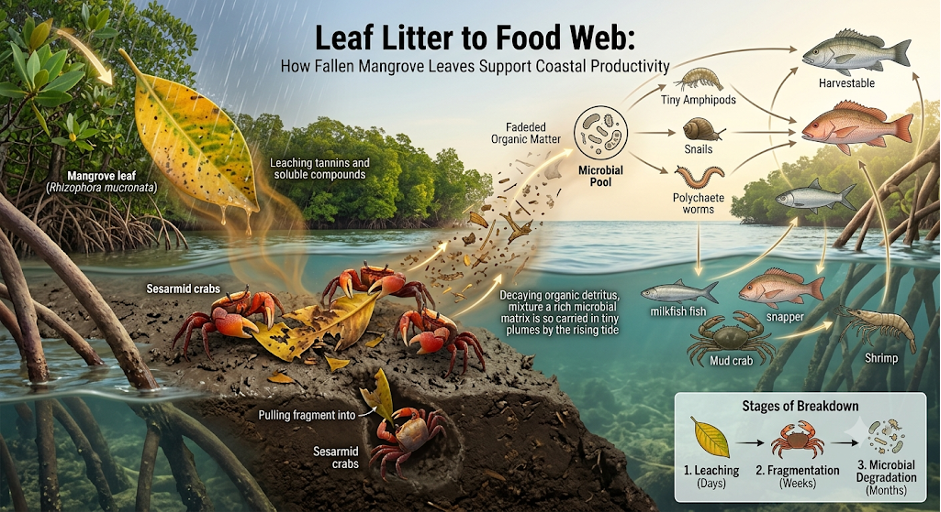
An overview of the mangrove detritus food web (Photo Credit : Generated by Gemini/AI Visuals)
A mangrove leaf turns yellow, dries, and eventually falls from the tree. It may land on the muddy forest floor, become trapped among the roots, or be carried away by the incoming tide. At first glance, it looks like nothing more than dead plant material, just another piece of debris accumulating along the shoreline.
But in a mangrove ecosystem, a fallen leaf is not the end of something. It is the beginning of a process. Once the leaf falls, rain and tidal water begin to wash out soluble compounds from its tissues. Bacteria and fungi colonize its surface, gradually breaking down the tougher plant material. Small animals such as crabs, snails, and amphipods feed on and fragment the decomposing leaf. As the material is broken down further, it becomes part of a much larger network of organisms and processes that moves energy and nutrients through the coastal ecosystem.
Some of this organic material remains within the mangrove forest. Some is transported by tides into creeks, estuaries, and surrounding coastal waters. Along the way, it supports microorganisms and small invertebrates, which in turn become food for larger animals.
Eventually, the energy that was once stored in a mangrove leaf can become part of the food web that supports shrimp, crabs, fish, and other coastal organisms.
So the story of a mangrove leaf does not end when it falls from the tree. In many ways, that is when its ecological role truly begins.
Why the Leaf Has to Fall First?
Mangrove leaves are not particularly attractive food while they are still attached to the tree. They are tough and fibrous and contain compounds such as tannins and other phenolic substances that can reduce their palatability and make them difficult for many animals to digest. As a result, mangrove leaves are generally not heavily grazed while they are still living, although some animals can consume fresh or recently fallen leaves.
Much of a mangrove tree's leaf production therefore enters the ecosystem as litter. But the important part of the story begins after the leaf falls. Exposure to rain and tidal water gradually removes soluble compounds, while bacteria and fungi colonize the leaf and begin breaking down its tougher components. As the leaf ages and decomposes, its chemical and nutritional characteristics change, making it increasingly available to detritivores and decomposers.
This transformation, from living plant tissue into decomposing organic matter that can be processed through multiple trophic pathways, is a defining feature of mangrove food-web dynamics. In the 1970s, William E. Odum heald described the importance of a detritus-based food web in an estuarine mangrove community, emphasizing the role of dead plant material and its subsequent processing within the ecosystem.
The key point is that a mangrove leaf does not become ecologically important only when an animal eats it directly. Its importance emerges through what happens after it falls: leaching, microbial colonization, fragmentation, consumption, and further decomposition. Together, these processes move organic matter through the mangrove food web and contribute to the productivity of the wider coastal ecosystem.
Three Stages of Breakdown
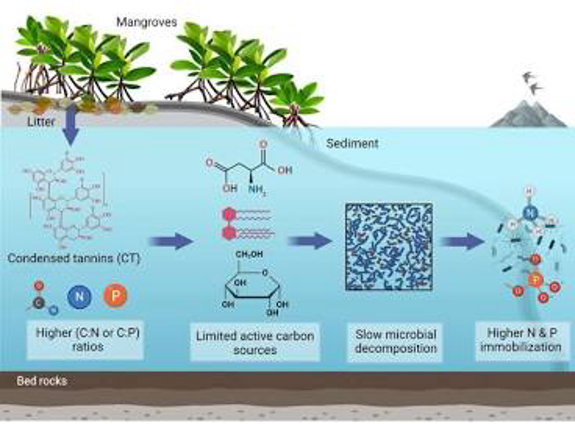
Mangrove leaf litter decomposition cycle (Photo Credit : Journal of Sea Research/Oecologia synthesis on litter decomposition/ResearchGate)
Once a leaf reaches the mud or water, its decomposition generally progresses through three overlapping stages: leaching, fragmentation, and microbial degradation (Zimmer, 2019):
- Leaching (days): Rainwater and tidal water wash soluble compounds out of the leaf, including salts, sugars, and other dissolved organic and inorganic substances. Tannins and other phenolic compounds can also be released during this early stage. In some mangrove species, substantial losses of tannins and other soluble components can occur within the first days of immersion. This initial loss of soluble compounds changes the chemical composition of the remaining leaf material and can increase its palatability to detritivores.
- Fragmentation (weeks): The remaining leaf material is gradually broken into smaller pieces by tidal movement, waves, sediment abrasion, and the feeding activities of animals such as crabs and other invertebrates. Fragmentation increases the surface area available for microbial colonization and can therefore accelerate subsequent decomposition. The activities of litter-consuming animals also influence how much organic matter remains within the mangrove and how much becomes available for further processing or export.
- Microbial degradation (weeks to months): Bacteria and fungi colonize the leaf surface and use extracellular enzymes to break down increasingly resistant components of the plant material, including cellulose, hemicellulose, and lignin. As decomposition progresses, microorganisms also incorporate carbon and nutrients from the detritus into their own biomass. This microbial transformation is important because it changes both the chemistry and nutritional quality of the decomposing material. Microbial biomass can increase the relative contribution of nitrogen-containing compounds, amino acids, proteins, and lipids within the detrital matrix, making the material more nutritionally valuable to organisms feeding on it. So by this stage, the material is no longer simply a fallen leaf. It has become a dynamic mixture of partially degraded plant material, microorganisms, and associated organic compounds, an important resource for the organisms that process mangrove detritus.
The process does not follow exactly the same timeline in every mangrove forest. Species, leaf chemistry, temperature, tidal inundation, oxygen availability, and the abundance of litter-consuming fauna can all influence how quickly decomposition occurs.
The Shredder Crew
Once mangrove leaves begin to accumulate on the forest floor, a range of small animals starts to interact with them. Crabs, snails, amphipods, and other invertebrates feed on, fragment, transport, or otherwise process the developing litter.
Among them, sesarmid crabs are particularly important litter processors in many mangrove forests. They can consume fallen leaves directly, break them into smaller pieces, and carry them into their burrows.
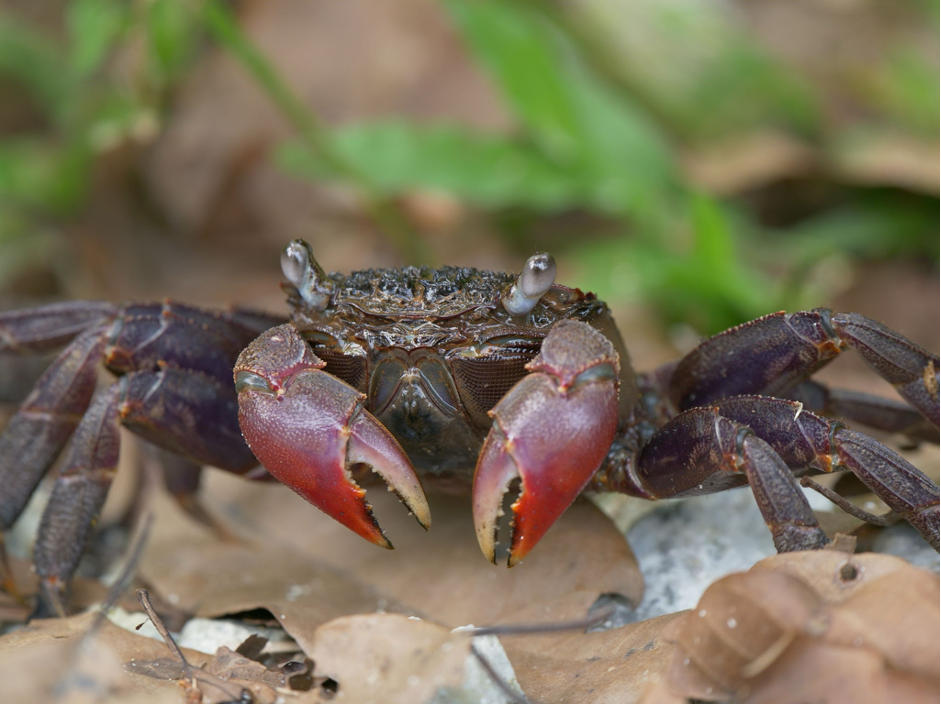
Sesarmid crab processing leaf litter (Photo Credit : Kum Leong Yeam/Getty Images)
The scale of this activity can be substantial. In high-intertidal mangrove forests in tropical Australia, Robertson and Daniel (1989) estimated that crabs removed around 71–79% of the annual leaf fall from the forest floor. In a mangrove forest in Phuket, Thailand, Thongtham et al. (2008) found that sesarmid crabs could remove up to 87% of daily leaf litter, either consuming it directly or transporting it into their burrows.
These numbers should not be interpreted as a universal rate for all mangrove forests. Litter removal varies with crab abundance, mangrove species, tidal conditions, litter quality, and the structure of the forest. What the studies do demonstrate is the potentially large role of crabs in processing mangrove leaf litter.
And the story does not end when a crab eats the leaf.
Crabs do not completely digest the tough structural components of mangrove leaves. Material that passes through their digestive systems is returned to the sediment as fecal matter, where it can be further processed by bacteria and fungi. Meanwhile, leaves transported into crab burrows are moved from the forest floor into the sediment, where they become part of a different microbial and biogeochemical environment.
In this way, crabs function as more than consumers. They are ecosystem processors: breaking apart leaves, redistributing organic matter, and changing where and how that material is subsequently decomposed.
A fallen leaf may begin as a piece of plant litter, but after passing through the activities of crabs and other detritivores, it becomes part of a much more complex network of organic matter processing within the mangrove ecosystem.
Where the Leftovers Go?
Not everything gets used up inside the forest. Tides carry a portion of the fragmented and microbe-colonized litter out of the mangrove and into tidal creeks and adjacent coastal waters, as both dissolved and particulate organic matter. Odum and Heald (1975) described this outward movement as part of the “outwelling” concept, the idea that mangrove and estuarine wetlands can export organic matter beyond their boundaries, potentially contributing to productivity in adjacent coastal waters.
Later research has confirmed that mangrove-derived organic matter is exported, although the amount varies considerably among ecosystems and depends on factors such as tidal exchange, hydrology, forest structure, and decomposition processes (Kristensen et al., 2008).
Turning Detritus into Dinner
The organic matter processed within the mangrove, together with material exported into nearby waters, becomes part of a food web that includes worms, small crustaceans, molluscs, and other invertebrates, which in turn can support larger animals such as shrimp, crabs, and fish.
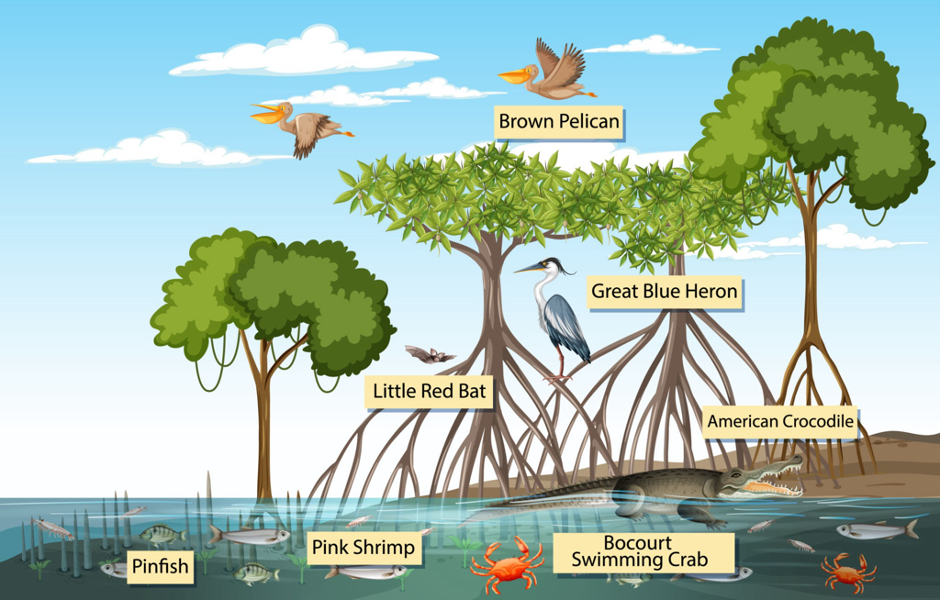
Mangrove habitat and associated species (Photo Credit : blueringmedia/Getty Images)
Mangroves also provide important nursery habitat for many coastal species. Their roots and shallow waters offer shelter, while the abundance of small organisms and organic matter provides feeding opportunities for juveniles (Nagelkerken et al., 2008). As they grow, some fish and other animals move to adjacent habitats such as seagrass beds, coral reefs, estuaries, or open coastal waters.
Indonesia sits close to the center of this story. Its extensive mangrove forests occur alongside productive fisheries and coastal aquaculture systems, including those supporting milkfish, shrimp, and mud crab. The connection is not simply that these animals “eat mangrove leaves,” but that mangroves contribute food, habitat, and organic-matter pathways within the broader coastal ecosystem.
A Necessary Caveat
It is tempting to tell a simple story: mangrove leaves fall, animals eat the resulting detritus, and the energy eventually reaches fish and other coastal species.
Early studies placed strong emphasis on this detritus pathway, based on observations of feeding patterns and the large quantities of mangrove litter entering the ecosystem (Odum & Heald, 1972). But later research using stable isotopes has shown that the picture is more complex.
In many mangrove systems, microscopic algae, including algae growing on the sediment surface and phytoplankton in the water, can make substantial contributions to the diets of fish and invertebrates. In some systems, their contribution may be greater than that of mangrove-derived organic matter (Bouillon et al., 2008).
This does not make mangrove litter unimportant. It simply means that mangrove ecosystems do not function through a single food pathway. Mangrove roots and sediments, fallen leaves, microorganisms, microalgae, tidal waters, and the animals that connect them all form part of a larger and interconnected coastal system.
The Takeaway
A muddy mangrove fringe covered with brown, half-decomposed leaves may not look particularly productive. But beneath that layer of litter, a complex process is taking place. Leaves are being broken down, processed by microorganisms and invertebrates, incorporated into sediments, and transported by tides into surrounding waters.
Not every fish or shrimp depends directly on mangrove-derived material, and mangrove litter is only one of several pathways supporting coastal food webs. But the forest provides a combination of organic matter, habitat, sediment processes, and connectivity that together help sustain coastal productivity.
That is why losing a mangrove forest means more than losing trees. It means altering the ecological processes and connections that allow energy, nutrients, and organisms to move through the coastal system.
-Rika Novida
References
Bouillon, S., Connolly, R. M., & Lee, S. Y. (2008). Organic matter exchange and cycling in mangrove ecosystems: Recent insights from stable isotope studies. Journal of Sea Research, 59(1–2), 44–58.
Kristensen, E., Bouillon, S., Dittmar, T., & Marchand, C. (2008). Organic carbon dynamics in mangrove ecosystems: A review. Aquatic Botany, 89(2), 201–219.
Nagelkerken, I., et al. (2008). The habitat function of mangroves for terrestrial and marine fauna: A review. Aquatic Botany, 89(2), 155–185.
Odum, W. E., & Heald, E. J. (1972). Trophic analyses of an estuarine mangrove community. Bulletin of Marine Science, 22(3), 671–738.
Odum, W. E., & Heald, E. J. (1975). The detritus-based food web of an estuarine mangrove community. In L. E. Cronin (Ed.), Estuarine Research, Vol. 1 (pp. 265–286). Academic Press.
Pradisty, N. A., Amir, A. A., & Zimmer, M. (2021). Plant species- and stage-specific differences in microbial decay of mangrove leaf litter: The older the better? Oecologia, 195(4), 843–858.
Robertson, A. I., & Daniel, P. A. (1989). The influence of crabs on litter processing in high intertidal mangrove forests in tropical Australia. Oecologia, 78(2), 191–198.
Thongtham, N., Kristensen, E., & Puangprasan, S.-Y. (2008). Leaf removal by sesarmid crabs in Bangrong mangrove forest, Phuket, Thailand; with emphasis on the feeding ecology of Neoepisesarma versicolor. Estuarine, Coastal and Shelf Science, 80(4), 573–580.
Zimmer, M. (2019). Detritus. In S. E. Jørgensen & B. D. Fath (Eds.), Encyclopedia of Ecology (2nd ed., Vol. 3, pp. 292–301). Elsevier.