

A Tangled Underwater World
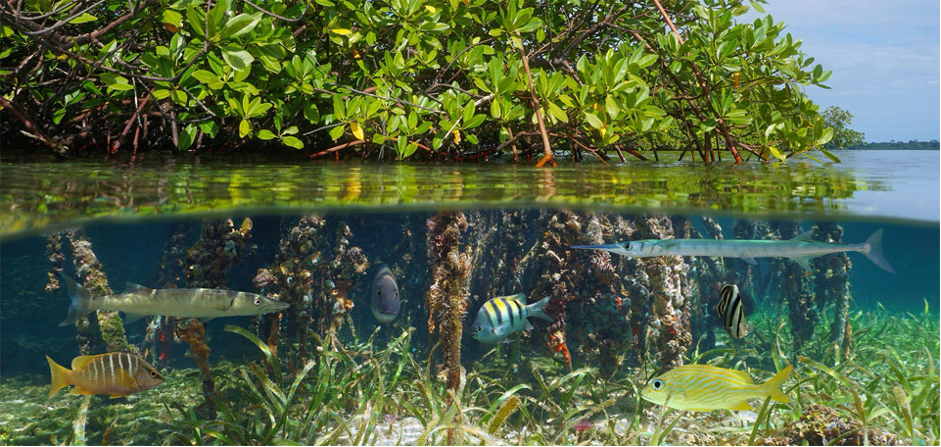
Photo Credit : Natural Habitat Adventures
Step into the shallow waters of a mangrove forest and you will find two very different worlds. Above the surface, everything seems calm; green leaves, quiet branches, and the occasional bird resting overhead. Beneath the water, however, a maze of roots twists and crisscrosses in every direction.
At first glance, this underwater tangle may look chaotic. But for a young fish, shrimp, or crab, it is one of the safest places in the coastal environment. The roots provide shelter from predators, slow down water currents, and create conditions where food is never far away.
This is why mangroves are often called nature's nurseries. Many marine species spend the earliest and most vulnerable stages of their lives among mangrove roots before moving to seagrass beds, coral reefs, or open waters as adults. What looks like a tangled mess is actually a highly effective survival system.
What Does "Nursery Habitat" Actually Mean?
Scientists use the term nursery habitat to describe places where young animals have a better chance of surviving and growing than they would elsewhere.
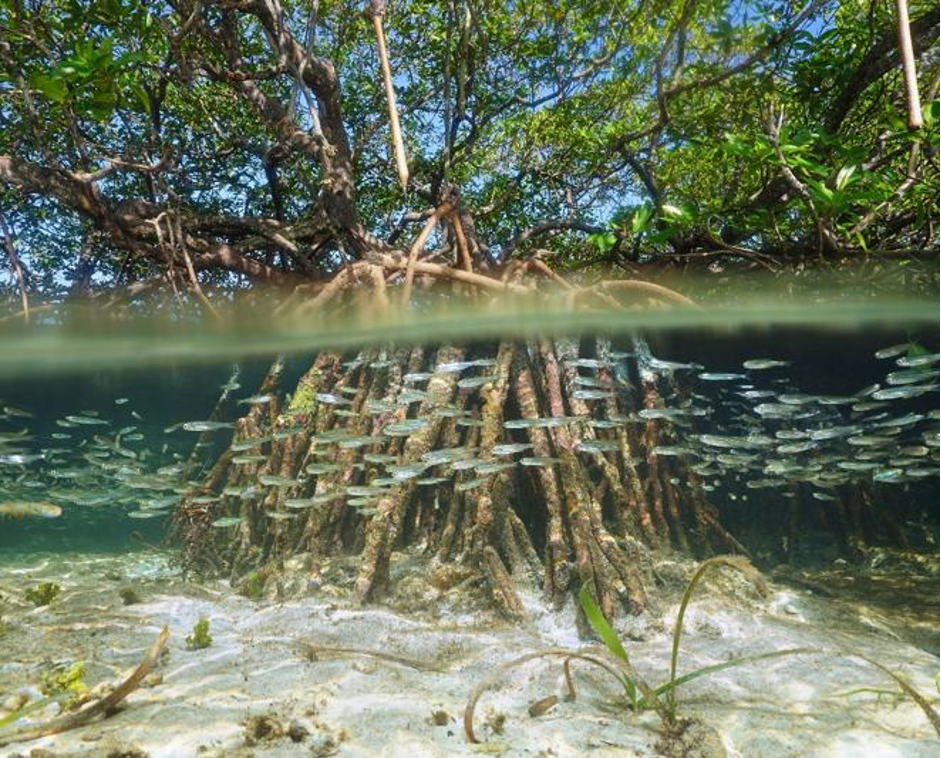
Mangrove roots as nursery habitat (Photo Credit : Damsea/Shutterstock)
A true nursery is not simply a place where juvenile fish and shrimp are found It's a place where young fish, shrimp, crabs, and other small creatures have a better chance of surviving, growing, and reaching adulthood than they would somewhere else. A study tracking reef fish from juveniles to adulthood found that a large share of adult fish had spent their younger days living in mangroves, seagrass beds, or reefs before settling permanently as adults, and for some species, almost all the adults caught out on the reef had passed through mangrove habitats earlier in life (Kimirei, 2013).
This kind of evidence is what makes mangroves more than just a "nice place to visit" for young fish, they're a real stepping stone toward adulthood, with effects that show up even years later, far out on the reef.
The Hideout: Roots as a Shield Against Predators
For a small fish swimming in open water, danger is everywhere. Larger predators can easily spot and chase their prey. Inside a mangrove forest, however, the story changes.
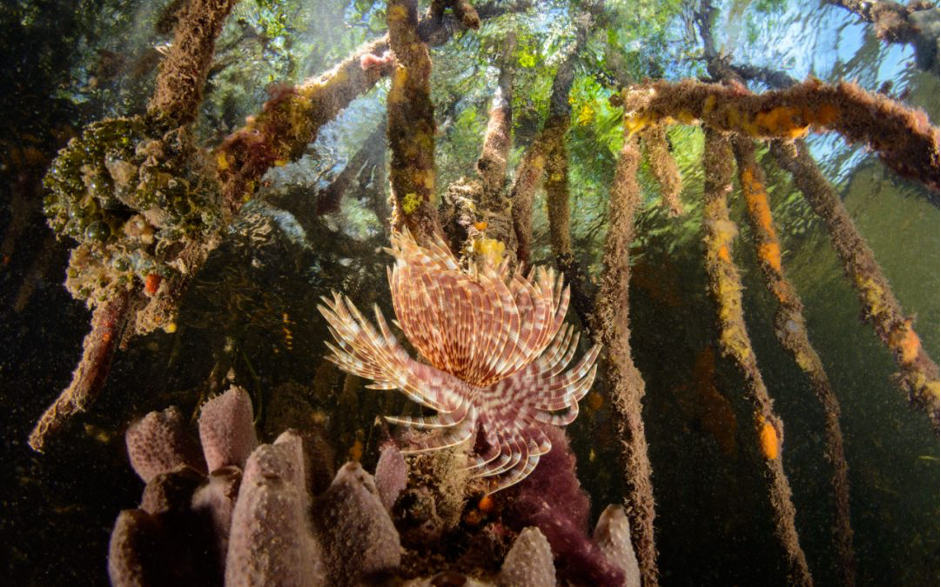
Mangrove roots are a complex habitat that function as a protective nursery for juvenile fish (Photo Credit : Eiko Jones)
The dense network of roots acts as a natural barrier. This kind of underwater hideout isn't limited to young fish, either. A recent study on reef backwaters found that mangrove trees gave fish a place to shelter from predators even on reef flats that otherwise had very little cover, with some fish species gathering in groups of more than twenty individuals around a single mangrove tree. In areas with few caves or large rocks to hide behind, a single mangrove tree's tangled roots could be the only real shelter available (Hammerstein, 2024).
Research from mangrove ecosystems around the world consistently shows the same pattern: areas with denser root structures tend to support more juvenile fish and higher survival rates. For young marine animals, crowded roots can mean the difference between life and death.
More Than a Hideout: A Buffet of Food
Protection is only part of the story. Young fish and shrimp also need a reliable food supply. Mangrove roots slow down water movement and trap sediments, creating ideal surfaces for algae and microorganisms to grow.
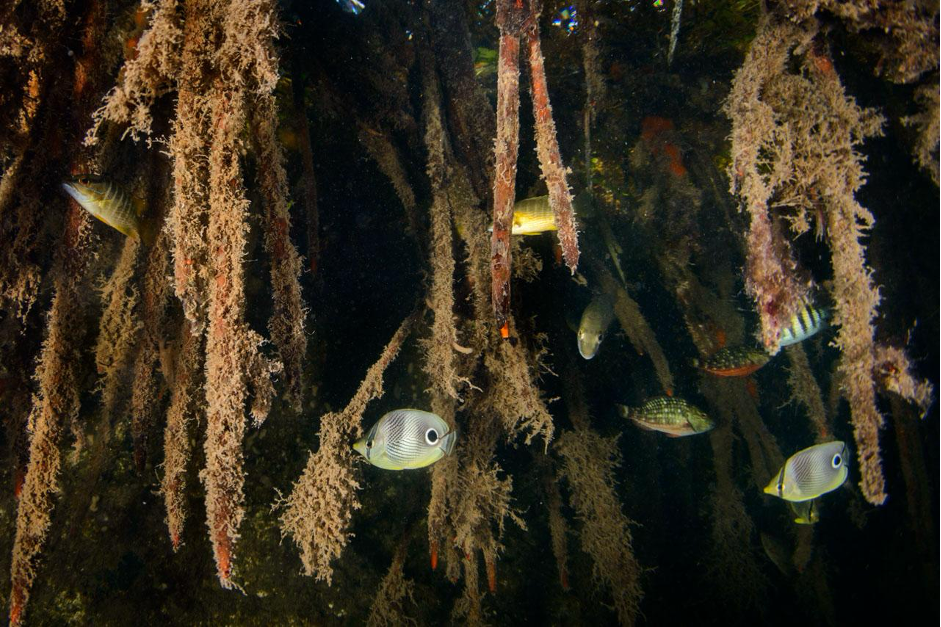
Fishes find food, shelter, and protection within the tangled roots of a mangrove forest (Photo Credit : Eiko Jones)
A thin, slimy layer called periphyton; a mix of algae, bacteria, and tiny microbes, coats almost every surface of a mangrove root that sits underwater. Field experiments comparing real and artificial mangrove roots found that substrate covered in biofilms and epiphytic growth served as an important food source, with daytime feeders being mainly drawn to mangrove and seagrass habitats because of this food, while the presence of predators made juveniles favor mangroves even more strongly as shelter. In other words, the same tangle that hides a young fish from danger also happens to be covered in its next meal, just centimeters away (Gartside&Smith, 2013).
This isn't only useful to know for wild mangroves—it has practical value too. In aquaculture systems that combine shrimp farming with mangrove planting, increasing the surface area available for periphyton to grow on raises the amount of natural feed available for shrimp and milkfish, while the roots themselves also give shrimp a place to hide from predatory fish.
The Numbers Don't Lie
The ecological benefits of mangroves are not just theoretical, they can be measured. Studies have found that fish abundance in mangrove habitats can be up to 35 times greater than in nearby seagrass beds, which are themselves highly productive ecosystems. Global reviews of nursery habitats have repeatedly shown that vegetated coastal habitats, including mangroves, support higher survival, growth, and abundance of juvenile fish compared with unvegetated areas.
When the same pattern appears across different regions, species, and studies, it becomes clear that mangroves play a unique role in supporting marine life.
From Mangrove Nursery to the Open Sea
Mangroves are not the final destination for most marine species. They are the starting point. As fish, crabs, and shrimp grow larger, they gradually leave the protection of mangrove roots and move into seagrass beds, coral reefs, and offshore waters. Many commercially important species follow this journey during their life cycle.
This means that mangroves, seagrasses, and coral reefs are closely connected. Damage to one habitat can affect species that spend much of their lives somewhere else.
Why This Matters in Indonesia
For Indonesia, the importance of mangroves goes far beyond biodiversity conservation. Mangroves support many of the fish, shrimp, and crab species that sustain coastal fisheries and local livelihoods. When mangrove forests are degraded or converted to other land uses, their nursery function declines, reducing the number of young animals that survive to adulthood.
Studies from Indonesian coastal areas, including Muara Gembong, have shown that healthy nursery habitats depend not only on mangrove cover but also on good water quality and strong community stewardship. Protecting mangroves therefore means protecting both ecosystems and the livelihoods that depend on them (Nastiti et al., 2021).
Why Protecting Roots Means Protecting Fisheries
Most people notice the green canopy of a mangrove forest. Yet the real ecological engine lies beneath the water, hidden among the roots. These roots provide shelter, food, and a safe place for young marine animals to grow. They support the early life stages of fish, shrimp, and crabs that later populate coastal waters, coral reefs, and fishing grounds.
Protecting mangroves is therefore about more than saving trees. It is about safeguarding the foundation of coastal food webs and ensuring the long-term sustainability of fisheries. Every healthy mangrove root system represents an investment in future marine productivity, and ultimately, in the communities that depend on it.
-Rika Novida
References
Kimirei, I. A., Nagelkerken, I., Mgaya, Y. D., & Huijbers, C. M. (2013). The mangrove nursery paradigm revisited: Otolith stable isotopes support nursery-to-reef movements by Indo-Pacific fishes. PLOS ONE, 8(6), e66320. https://doi.org/10.1371/journal.pone.0066320.
Saenger, P., Gartside, D., & Funge-Smith, S. (2013). A review of mangrove and seagrass ecosystems and their linkage to fisheries and fisheries management (RAP Publication 2013/09). Food and Agriculture Organization of the United Nations, Regional Office for Asia and the Pacific. https://www.fao.org/4/i3355e/i3355e.pdf.
Nastiti, A. S., Mujianto, Putri, M. R. A., Hedianto, D. A., Indriatmoko, & Haryadi, J. (2021). Penentuan kawasan asuhan udang sebagai salah satu opsi konservasi di Perairan Muara Gembong. Jurnal Akuatika Indonesia, 6(1), 1–10.