

How Tidal Flooding Shapes Nutrient Cycling in Mangrove Ecosystems
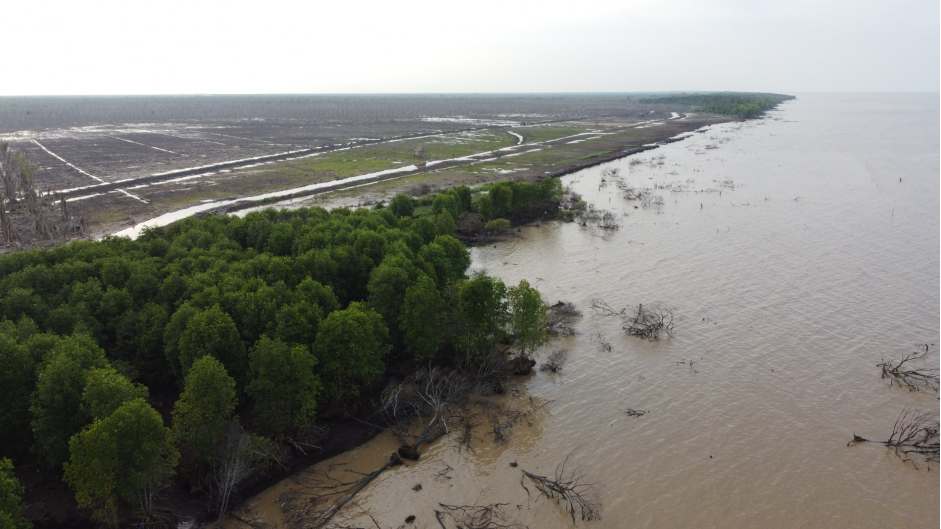
An aerial photo of tidal flooding at mangrove forest in Riau (Photo Credit : Imam Taufik)
Mangrove ecosystems occupy the dynamic boundary between land and sea, thriving in coastal regions where tidal waters regularly flood and drain the landscape. These unique forests provide a wide range of ecological services, including shoreline protection, carbon sequestration, biodiversity support, and fisheries enhancement. Among their most important yet often overlooked functions is their role in nutrient cycling—a process that sustains productivity both within mangrove forests and in adjacent coastal environments.
Tidal flooding is a defining characteristic of mangrove ecosystems. The periodic movement of seawater into and out of mangrove forests influences the transport, transformation, storage, and release of nutrients such as nitrogen, phosphorus, carbon, and silica. Through these processes, tides act as a natural engine that connects terrestrial, estuarine, and marine ecosystems.
Understanding how tidal flooding shapes nutrient cycling is essential for managing mangrove habitats, predicting ecosystem responses to climate change, and maintaining the ecological benefits that coastal communities depend upon.
Tidal Flooding as a Nutrient Transport Mechanism
Every tidal cycle brings water, sediments, organic matter, and dissolved nutrients into mangrove forests. When the tide rises, nutrient-rich water enters creeks, channels, and forest floors. As the tide recedes, some nutrients are exported back to estuaries and coastal waters.
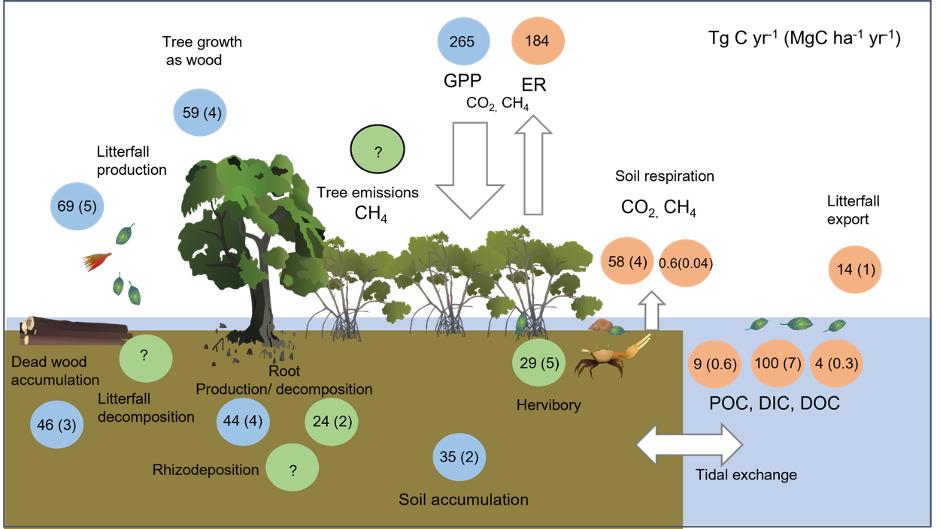
Diagram showing incoming and outgoing tides carrying nutrients (Photo Credit : Queensland Government)
This bidirectional exchange creates a highly connected ecosystem where nutrients are continuously redistributed.
- Import of Nutrients
Incoming tides transport nutrients from:
- Coastal waters
- Estuaries
- Rivers
- Adjacent wetlands
- Offshore marine environments
These nutrients become available for uptake by mangrove roots, microorganisms, algae, and other organisms inhabiting the forest.
- Export of Nutrients
Outgoing tides carry:
- Dissolved organic carbon
- Leaf litter fragments
- Decomposed organic matter
- Nutrient-rich sediments
- Microbial biomass
This exported material supports productivity in nearby seagrass meadows, mudflats, coral reefs, and fisheries habitats.
The regular import and export of nutrients through tidal flooding creates what scientists often describe as a “tidal pump,” continuously moving materials between ecosystems.
Sediment Deposition and Nutrient Storage
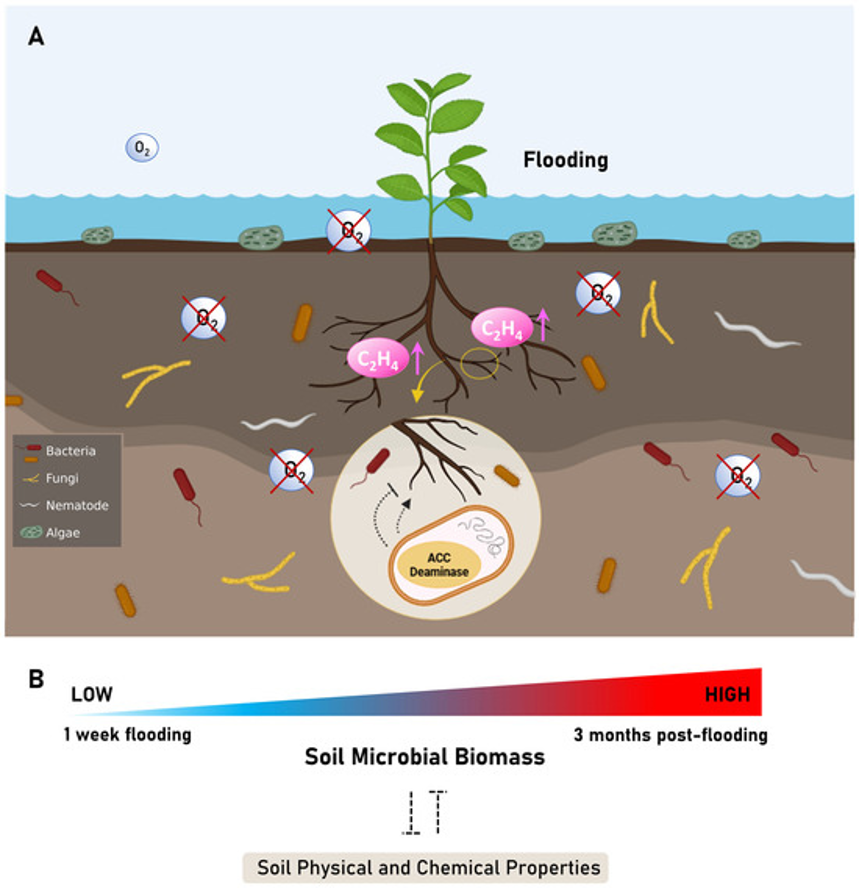
Tidal flooding-induced changes in soil microbial communities and the associated ecosystem processes (Photo Credit : Ashim Kumar Das, et al.)
Tidal flooding also plays a major role in sediment dynamics. As tidal waters slow down within dense mangrove root systems, suspended sediments settle onto the forest floor.
These sediments often contain:
- Organic matter
- Nitrogen compounds
- Phosphorus
- Trace minerals
- Micronutrients
Mangrove roots act as natural sediment traps, increasing the retention of nutrient-rich particles.
Over time, accumulated sediments become important nutrient reservoirs. Nutrients stored within sediments can later be released through biological and chemical processes, making them available for plant growth and microbial activity.
In many tropical coastlines, mangrove forests capture significantly more sediment than adjacent unvegetated areas, highlighting their importance in nutrient retention and coastal stabilization.
Decomposition and Nutrient Recycling
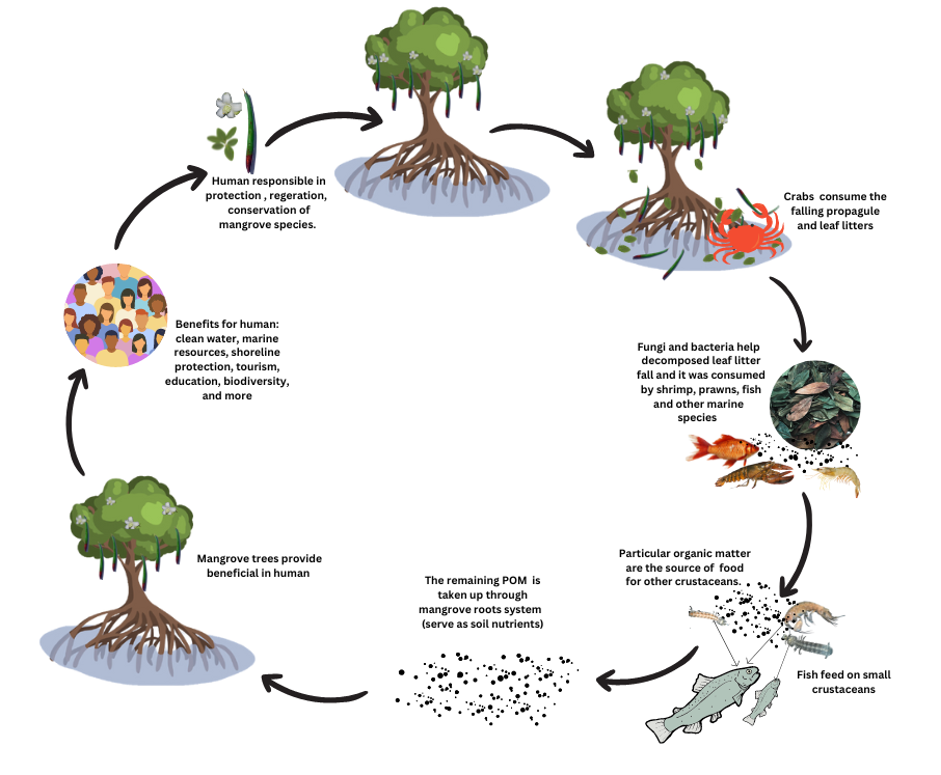
Mangrove decomposition and nutrient recycling diagram (Photo Credit : Lizel L. Sabino and Edison D. Macusi)
Mangrove forests generate large amounts of organic matter through falling leaves, twigs, flowers, fruits, and dead roots. Tidal flooding influences how this material is decomposed and recycled.
- Leaf Litter Breakdown
Mangrove leaf litter accumulates on the forest floor and undergoes decomposition by:
- Bacteria
- Fungi
- Crabs
- Insects
- Other detritivores
Periodic flooding keeps the litter moist, promoting microbial activity and accelerating decomposition.
As organic matter breaks down, nutrients are released into the soil and water, where they can be reused by plants and microorganisms.
- Formation of Detritus
Partially decomposed plant material forms detritus, a critical component of coastal food webs. Tidal waters transport detritus throughout the ecosystem, providing food for:
- Small fish
- Shrimp
- Crustaceans
- Mollusks
- Zooplankton
This process links nutrient cycling within mangroves to broader coastal productivity.
Influence on Nitrogen Cycling
Nitrogen is often a limiting nutrient in coastal ecosystems, making its cycling particularly important.
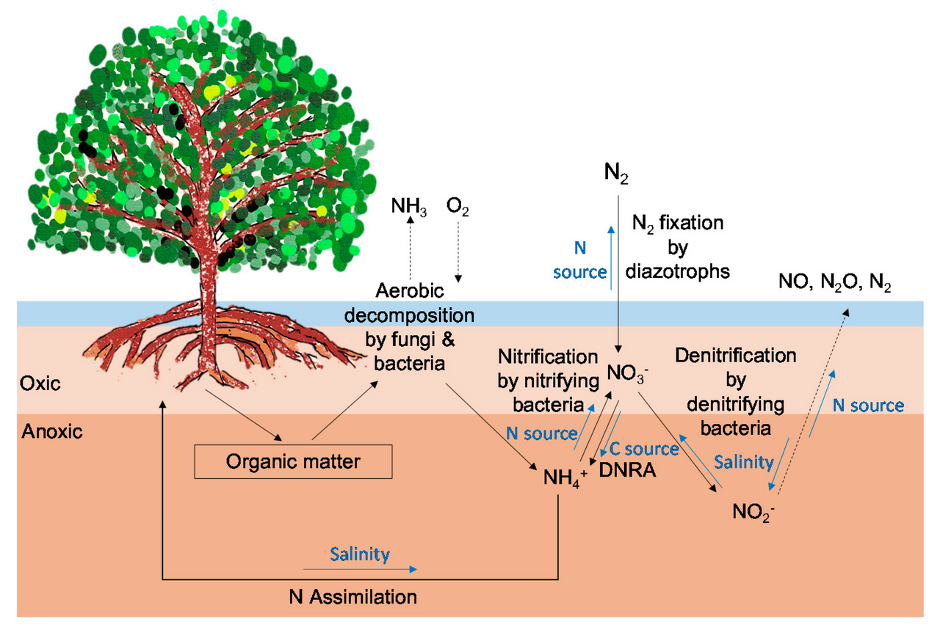
Pathways for the nitrogen cycle in mangrove forests (Photo Credit : Yo-Jin Shiau and Chih-Yu Chiu)
Tidal flooding affects nitrogen dynamics through several biological processes:
- Nitrogen Fixation
Certain microorganisms can convert atmospheric nitrogen into forms usable by plants. These nitrogen-fixing bacteria often inhabit mangrove sediments and root surfaces.
Regular tidal inundation creates environmental conditions that support microbial communities involved in nitrogen fixation.
- Nitrification and Denitrification
Mangrove soils experience alternating periods of flooding and exposure. These changing conditions create zones with different oxygen levels.
In oxygen-rich conditions:
- Ammonium is converted into nitrate through nitrification.
In oxygen-poor conditions:
- Nitrate is converted into nitrogen gas through denitrification.
Tidal flooding regulates the balance between these processes, influencing the overall availability of nitrogen within the ecosystem.
- Nutrient Exchange with Coastal Waters
Floodwaters transport dissolved nitrogen compounds between mangrove forests and adjacent estuaries. This exchange helps maintain nutrient balance across coastal landscapes.
Carbon Cycling and Blue Carbon Storage
Mangroves are globally recognized as important blue carbon ecosystems. They capture atmospheric carbon dioxide through photosynthesis and store large amounts of carbon in their biomass and soils.
Tidal flooding plays a central role in this process.
- Carbon Burial
Floodwaters deposit sediments rich in organic matter. Because mangrove soils are often waterlogged and oxygen-poor, decomposition occurs slowly.
As a result:
- Organic carbon accumulates in sediments.
- Carbon remains buried for decades to centuries.
- Long-term carbon storage increases.
- Carbon Export
Not all carbon remains within the ecosystem. Tidal exchange transports dissolved organic carbon and particulate organic carbon to surrounding coastal waters.
This exported carbon supports marine food webs and contributes to broader coastal carbon cycling.
The balance between carbon storage and carbon export is strongly influenced by tidal frequency, duration, and intensity.
Impacts of Climate Change on Tidal Nutrient Cycling
Climate change is altering tidal dynamics and nutrient cycling processes in many coastal ecosystems.
Key threats include:
- Sea-Level Rise
Rising sea levels can increase tidal inundation frequency and duration, potentially changing nutrient transport pathways and sediment deposition patterns.
- Changes in Storm Activity
More intense storms may increase sediment movement and nutrient fluxes, while also causing erosion and habitat degradation.
- Altered Rainfall Patterns
Changes in precipitation can affect freshwater inflows, nutrient concentrations, and salinity levels within mangrove forests.
- Coastal Development
Human modifications such as seawalls, land reclamation, and drainage infrastructure can disrupt natural tidal flows, reducing nutrient exchange and ecosystem resilience.
Protecting natural hydrological connections is therefore essential for maintaining healthy nutrient cycling processes.
Tidal flooding is the driving force behind nutrient cycling in mangrove ecosystems, transporting and recycling nutrients, organic matter, and sediments that support plant growth, carbon storage, and coastal food webs. Maintaining natural tidal connectivity is essential for preserving the productivity, resilience, and ecological benefits that mangrove forests provide in a changing coastal environment.