
Fiddler Crabs: Small Creatures with a Big Role in Coastal Sediment Health
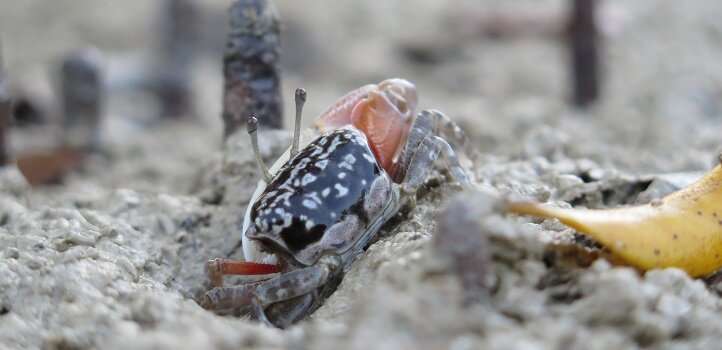
Fiddler crabs play an important role in sediment mixing in mangrove ecosystem (Photo Credit : Marco Fusi)
Along tropical and subtropical coastlines—especially in mangrove areas and estuaries with muddy substrates—live small crustaceans belonging to the class Malacostraca and family Ocypodidae. These organisms, known as fiddler crabs, typically measure around 2–5 cm in size.
Based on modern taxonomic revisions, the currently recognized main genera include Uca (Americas), Tubuca (Indo-Pacific), Austruca, Gelasimus, Leptuca, Minuca, and Afruca.
Fiddler crabs are easily recognized by the males’ distinctive enlarged claw, which is used for communication and attracting mates. They are considered exotic coastal fauna, characterized by a trapezoid-shaped carapace, elongated eye stalks, and species-specific color variations.
Although often overlooked, recent decades of international research have increasingly highlighted the ecological importance of fiddler crabs—from nutrient cycling to climate change mitigation. Based on recent scientific findings, their ecological roles can be summarized as follows:
Fiddler Crabs as Ecosystem Engineers
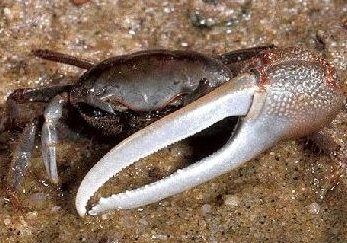
Fiddler crab (Photo Credit : NOAA)
Fiddler crabs are known as ecosystem engineers, meaning organisms that can modify their surrounding physical and biological environment. Their primary activity is burrowing into coastal sediments.
These burrows serve not only as shelter but also influence soil structure and ecosystem dynamics. Recent studies show that burrowing increases sediment heterogeneity and facilitates oxygen flow into deeper soil layers.
As a result, fiddler crabs indirectly create conditions that support microorganisms and other benthic organisms, making them key drivers in maintaining the productivity of mangrove and coastal wetland ecosystems.
Role in Nutrient and Biogeochemical Cycles
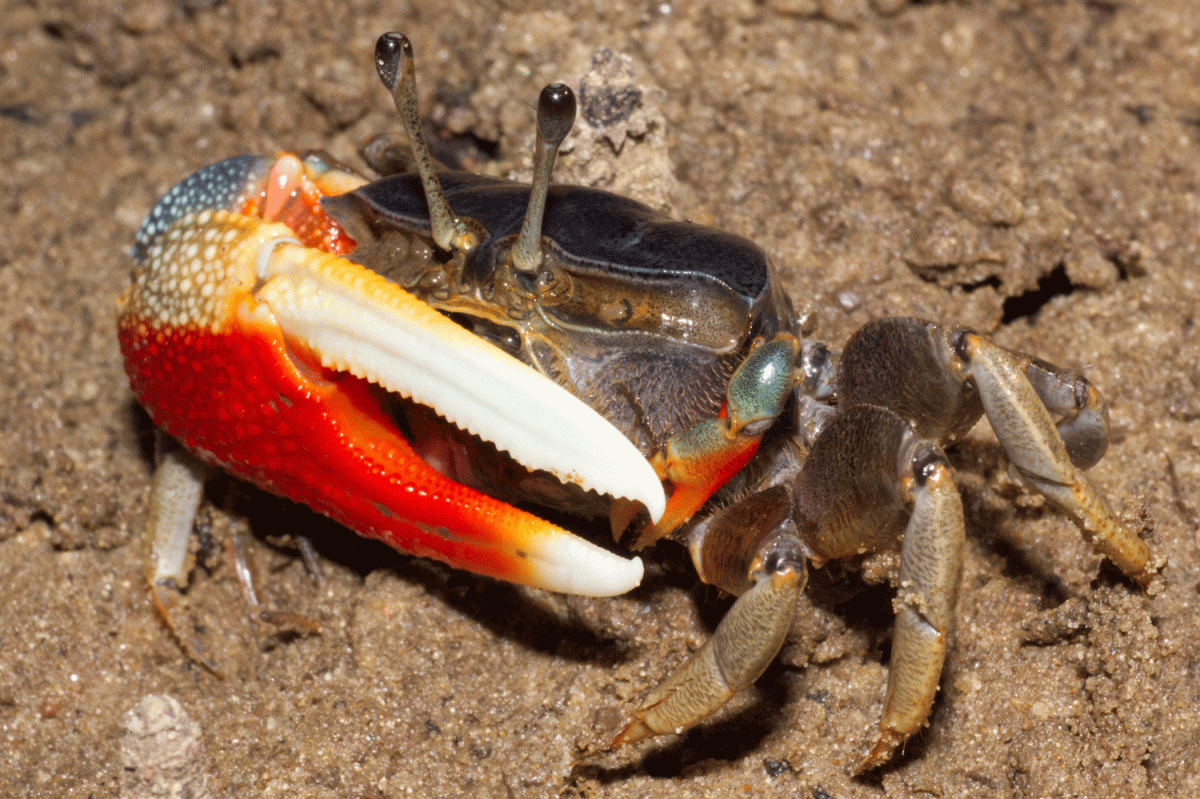
Colourful male fiddler crab Tubuca dussumieri) (Photo Credit : Denis Riek)
One of the most significant contributions of fiddler crabs is through bioturbation, the mixing of sediments caused by organism activity.
This process has major impacts on carbon, nitrogen, and sulfur cycles in coastal ecosystems. A study by Qin et al. (2024) showed that fiddler crab bioturbation can alter soil microbial communities and accelerate organic matter decomposition.
Their burrowing increases sediment aeration, allowing aerobic microorganisms to thrive. However, this process also has a complex side: it can increase greenhouse gas emissions such as methane (CH₄) from mangrove soils.
Other studies have shown that crab burrows can increase CO₂ emissions by 17–30% and methane emissions by over 100% compared to undisturbed sediments.
This highlights their dual role—supporting nutrient cycling while also influencing the global carbon balance.
Influence on Mangrove Vegetation
The relationship between fiddler crabs and mangrove vegetation is complex and context-dependent.
In some cases, fiddler crabs promote plant growth by improving soil aeration and nutrient distribution. However, recent studies in the Americas found that under certain conditions, the expansion of fiddler crab species can reduce the growth of salt marsh grasses such as Spartina alterniflora.
This indicates that their ecological impact depends heavily on environmental conditions and species interactions. In other words, fiddler crabs are neither strictly “beneficial” nor “harmful”—they act as dynamic regulators of ecosystem balance.
Role in the Food Web
As benthic organisms, fiddler crabs play an important role in coastal food webs. They feed on detritus, microalgae, and organic material accumulated in sediments.
Through their feeding activity, they help recycle organic matter into forms more accessible to other organisms. Additionally, they serve as prey for various predators, including shorebirds, fish, and reptiles.
This makes fiddler crabs an important link between lower trophic levels (detritus) and higher trophic levels (predators), supporting overall ecosystem stability.
Indicators of Environmental Health
Fiddler crabs are also used as bioindicators of coastal environmental conditions. Changes in their behavior, population, and physiology can reflect environmental stress such as pollution, human disturbance, and climate change.
Crabs living in highly disturbed areas show altered behavior, including increased sensitivity to human presence. This makes them useful for monitoring environmental stress levels.
Other studies show that fiddler crabs are highly sensitive to marine heatwaves, particularly in degraded mangrove ecosystems. Their physiological responses to temperature stress make them valuable indicators in climate change research.
Unique Adaptations and Behavior
Fiddler crabs possess several adaptations that support their ecological roles. One of the most interesting is their efficient navigation and foraging behavior.
They use a navigation system based on path integration to return to their burrows after foraging. This allows them to explore wide areas without losing orientation.
Additionally, the “mudballs” or sediment pellets they form while feeding contribute to shaping the surrounding microhabitat structure.
Threats to Fiddler Crabs and Coastal Ecosystems
Despite their ecological importance, fiddler crab populations face numerous threats, primarily due to human activities.
Mangrove degradation, pollution, coastal urbanization, and climate change are major factors. Habitat destruction can reduce both the density and diversity of fiddler crab species.
Furthermore, rising temperatures and salinity changes associated with climate change can disrupt their physiological functions.
These threats impact not only fiddler crabs but also the entire coastal ecosystem that depends on their activities.
Implications for Conservation and Coastal Management
Understanding the role of fiddler crabs is essential for effective coastal conservation strategies. Because they influence nutrient cycles, soil structure, and carbon dynamics, their presence must be considered in mangrove and coastal wetland management.
An ecosystem-based management approach should include benthic fauna like fiddler crabs as key components. Additionally, effective mangrove restoration must account for interactions between vegetation and organisms such as crabs.
Conclusion
Fiddler crabs are a clear example of how small organisms can have a significant environmental impact. As ecosystem engineers, they modify sediments, regulate nutrient cycles, and influence carbon dynamics in coastal ecosystems.
Their role is not always straightforward—it can be beneficial or complex depending on environmental context. However, one thing is certain: without fiddler crabs, coastal ecosystems would not function in the same way.
Amid climate change and increasing anthropogenic pressures, understanding and protecting fiddler crabs is a crucial step toward sustaining global coastal ecosystems.
-Yuni Sulaiman
References
Martínez-Soto, K. S., et al. (2024). A fiddler crab reduces plant growth in its expanded range. Ecology.
Rodriguez, G. B., et al. (2024). Fiddler crabs from highly disturbed beaches are more sensitive to human presence. Anais da Academia Brasileira de Ciências.
Capparelli, M. V. (2025). Impacts of marine heatwaves on disturbed mangrove ecosystems: A biomarker-based assessment using fiddler crabs as sentinel species. Environmental Research.
Qin, G., et al. (2024). Fiddler crab bioturbation stimulates methane emissions in mangroves: Insights into microbial mechanisms. Soil Biology & Biochemistry, 194.
Yang, Y., et al. (2025). Differential mediation of biogeochemical processes through bioturbation by fiddler and sesarmid mangrove crabs. Marine Pollution Bulletin, 211.
Xiao, K., et al. (2024). Widespread crab burrows enhance greenhouse gas emissions from coastal blue carbon ecosystems. Communications Earth & Environment.
Chatterji, R., et al. (2024). Spatiotemporal structure of foraging and path integration errors by fiddler crabs (Leptuca pugilator). Frontiers in Marine Science, 11.
Lawerissa, Y. A., et al. (2025). Ecological aspects of fiddler crabs (Uca spp.) in the mangrove ecosystem of Poka Village, Inner Ambon Bay. Jurnal Kelautan Tropis.