Mangrove Restoration 2.0: Why Planting Trees Alone Is Not Enough
For decades, mangrove restoration has been approached in overly simplistic terms: planting as many seedlings as possible along degraded coastlines. At first glance, the logic seems sound: if mangrove forests are lost, then replanting should restore them. However, empirical evidence consistently shows otherwise. In many coastal regions, large-scale planting initiatives have resulted in extremely high seedling mortality, frequently surpassing 80% within the first few months.
This persistent failure does not stem from a lack of effort, but from a fundamental misinterpretation of mangrove ecosystem dynamics. Mangrove restoration is not merely about reintroducing vegetation, it is about restoring a complex, interdependent ecological system governed by hydrology, sediment processes, and species-specific adaptations.
This recognition marks a critical conceptual shift toward a more robust framework grounded in Nature-based Solutions (NbS), where restoration is designed to recover ecosystem functionality rather than simply increase tree cover.
Within this framework, success is no longer defined by the number of seedlings planted, but by the extent to which key ecological functions, such as sediment stabilization, coastal protection, habitat provision, and carbon sequestration, are effectively re-established and sustained over time.
From Tree Planting to Ecosystem Recovery
Mangroves are not isolated biological units. They are part of a tightly coupled socio-ecological system involving hydrodynamics, sediment processes, vegetation structure, and biotic interactions. Their ecological functions extend far beyond the presence of trees.
A fully functioning mangrove ecosystem:
- Stabilizes coastal sediments and reduces erosion
- Provides nursery habitats for fish and crustaceans
- Attenuates wave energy and storm surges
- Sequesters and stores significant amounts of carbon (blue carbon)
- Supports coastal livelihoods and local economies
When restoration efforts focus solely on planting, without restoring the underlying environmental conditions, the system remains dysfunctional. In such cases, seedlings are effectively introduced into an unsuitable habitat, where survival becomes biologically improbable.
Key Ecological Drivers Often Overlooked
Three primary ecological drivers determine the success or failure of mangrove restoration. These are well-established in coastal ecology yet frequently neglected in implementation.
- Hydrological Regime
Mangrove ecosystems are fundamentally shaped by tidal hydrology. The frequency, duration, and depth of tidal inundation regulate oxygen availability, salinity gradients, and nutrient exchange.
Disruptions to hydrological connectivity—such as dikes, aquaculture embankments, or poorly designed drainage canals—can fundamentally alter site conditions. In many failed restoration projects, the root cause is not inappropriate species selection, but impaired water flow.
Restoration, therefore, must begin with hydrological rehabilitation.
- Sediment Dynamics
Mangroves depend on fine-grained, organic-rich substrates. Sediment accretion processes are essential for root anchorage and nutrient availability.
Sites dominated by coarse sand or compacted soils are generally unsuitable for mangrove establishment. Furthermore, sediment supply must be sufficient to counterbalance coastal erosion and sea-level rise.
In many cases, mangroves cannot be successfully planted until natural sedimentation processes have been re-established.
- Ecological Zonation
Perhaps the most critical and most frequently violated principle in mangrove restoration is zonation.
Mangrove species are distributed along environmental gradients, particularly salinity, tidal inundation, and wave exposure. Each species occupies a specific ecological niche, shaped by physiological tolerance and competitive interactions.
Ignoring zonation leads to predictable failure. Planting the wrong species in the wrong zone is not a minor technical error, it is a fundamental ecological mismatch.
Understanding Zonation: The “Address System” of Mangroves
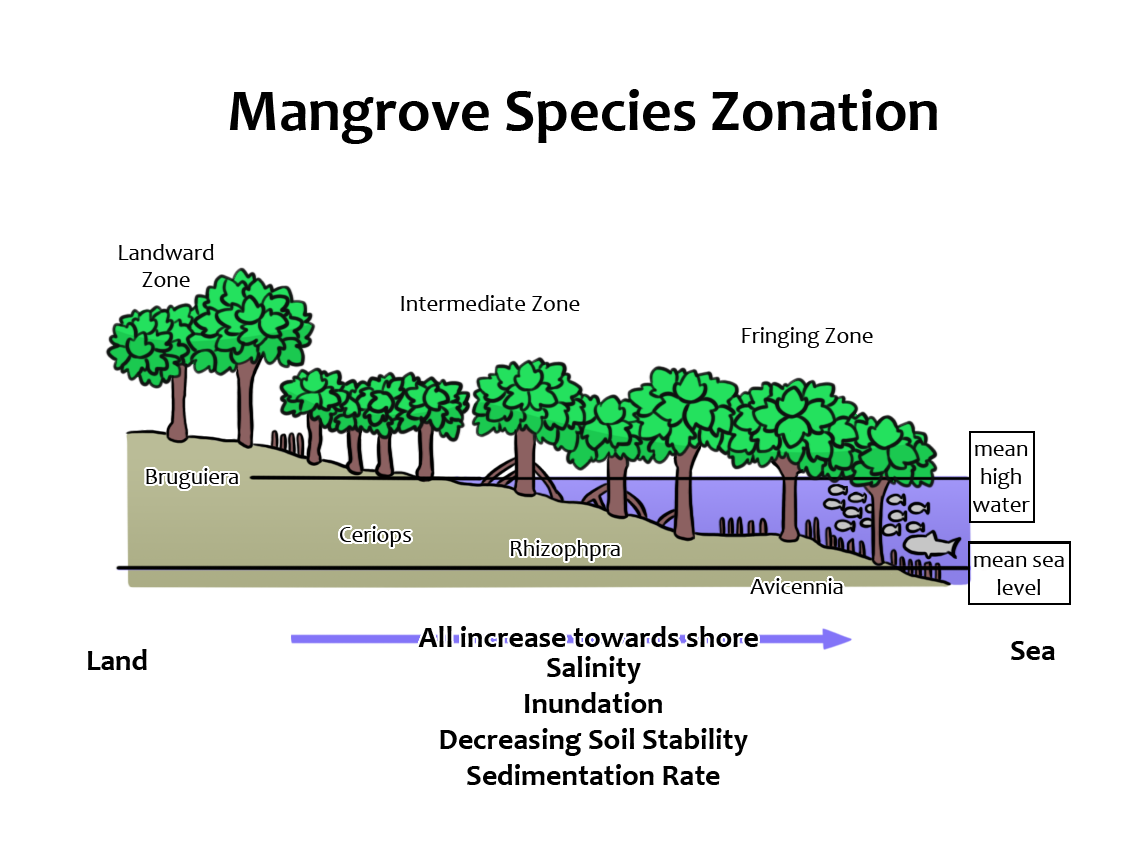
Mangrove species zonation (Photo Credit : Tyler Gantuangco)
Mangrove ecosystems exhibit a distinct spatial organization from the seaward edge to inland areas. This zonation reflects adaptation to environmental stress gradients and should guide any restoration effort.
- Seaward Fringe (Pioneer Zone)
Dominant genera: Avicennia and Sonneratia
This zone directly faces the open sea and is subjected to high salinity, strong wave action, and prolonged tidal inundation.
Key adaptations:
- Pneumatophores (aerial roots) for gas exchange in anoxic soils
- High tolerance to salinity and hydrodynamic stress
Ability to trap and stabilize incoming sediments
These pioneer species play a foundational role. Without them, the development of inland zones becomes unlikely.
- Intermediate Zone (Core Mangrove Forest)
Dominant genus: Rhizophora
This is the most recognizable mangrove zone, often forming dense, structurally complex forests.
Key characteristics:
- Stilt roots providing mechanical stability
- Efficient sediment trapping capacity
- Moderate tolerance to tidal inundation
Despite its prominence, Rhizophora is frequently misplanted in highly exposed coastal areas where it cannot survive early-stage hydrodynamic stress.
- Landward Zone (Protected Interior)
Dominant genera: Bruguiera and Xylocarpus
This zone experiences reduced tidal influence and greater freshwater input.
Key characteristics:
- Lower salinity tolerance compared to seaward species
- Preference for more stable, compact substrates
- Increased structural and species diversity
Species in this zone are less tolerant of prolonged flooding and cannot be transplanted toward the seaward edge.
- Transitional Zone
Dominant species: Nypa fruticans and Pemphis acidula
This zone marks the interface between mangrove ecosystems and terrestrial environments.
Key characteristics:
- Strong influence of freshwater inputs
- High socio-economic value (e.g., nipa palm for sugar and roofing materials)
- Functions as an ecological buffer between marine and terrestrial systems
Why Do Restoration Projects Fail?
Failure in mangrove restoration is rarely random. It is typically the result of systematic ecological misinterpretation.
Common mistakes include:
- Planting Rhizophora in high-energy coastal zones where pioneer species should dominate
- Ignoring altered hydrological conditions
- Overlooking sediment requirements
- Prioritizing numerical planting targets over ecological outcomes
Such approaches often stem from short-term project metrics rather than long-term ecosystem functionality. In ecological terms, this can be described as maladaptive restoration; interventions that fail to align with environmental conditions.
Mangrove Restoration 2.0: A Nature-based Solutions Approach for Coastal Resilience
Mangrove Restoration 2.0 represents a shift from intervention-heavy strategies toward ecosystem-informed management.
Key principles include:
- Restore Processes Before Planting
Hydrology must be reconnected and sediment dynamics reactivated before any planting takes place.
- Facilitate Natural Regeneration
In many degraded sites, natural recruitment can occur once environmental conditions are restored. Assisted natural regeneration is often more effective than active planting.
- Apply Targeted Planting
Planting should be used selectively, based on ecological suitability and species-site matching.
- Integrate Socio-Economic Systems
Sustainable restoration must incorporate local livelihoods. Approaches such as silvofisheries demonstrate that ecological restoration and economic productivity can coexist.
Conclusion: From Planting Trees to Restoring Systems
Successful mangrove restoration requires a conceptual shift: from viewing mangroves as individual trees to understanding them as components of a living system governed by ecological processes.
This approach demands scientific rigor, patience, and humility. Rather than imposing solutions on nature, restoration practitioners must work with natural processes.
When implemented correctly, mangrove ecosystems can recover their full functionality providing coastal protection, enhancing biodiversity, sequestering carbon, and sustaining human communities.
Ultimately, mangrove restoration is not about planting trees. It is about rebuilding resilience at the interface between land and sea.
-Rika Novida